Best Proxies for Academic Web Research in 2026
The best proxies for academic web research in 2026 — ranked on ethical IP sourcing, reliability, geo-coverage, and compliance, plus the ethics of research scraping.

Modern research runs on data you have to collect yourself. Whether you are scraping citation networks, gathering pricing data for an economics paper, tracking public health signals, or building a corpus for an NLP model, the web is your dataset — and it does not hand itself over politely. Hit a scholarly database too fast and you are rate-limited; request a journal from the wrong country and you are geo-blocked; run a large crawl from one IP and it is dead within the hour.
Proxies solve all three. They spread your requests across many IP addresses so you can collect data at scale, reliably, and from the right locations. But academic work carries a responsibility that commercial scraping often ignores: your methods have to be as ethical as your conclusions. An ethically sourced, transparent proxy network is not a nice-to-have for research — it is part of doing the work properly.
This guide covers the best proxies for academic web research in 2026, the criteria that actually matter for research (including ethical IP sourcing), a clear look at residential vs datacenter, and an honest section on the ethics and legality of academic scraping that most roundups skip entirely. Let us find the right tool for your study.
Why Academic Research Needs Proxies
Three recurring walls stop research data collection, and proxies clear all of them.
The first is rate limiting. Sites like Google Scholar, PubMed, and public databases throttle or block IPs that send many requests quickly. Rotating proxies spread your crawl across thousands of IPs so no single one trips the limit — the same reason proxies are essential for web scraping at scale.
The second is geo-restriction. Journals, government portals, and regional datasets often serve different content — or nothing at all — depending on where you connect from. A proxy in the right country makes that content accessible for legitimate study. The third is simple reliability: a large research crawl that dies halfway leaves you with a biased, incomplete dataset. Quality proxies keep collection consistent from start to finish.
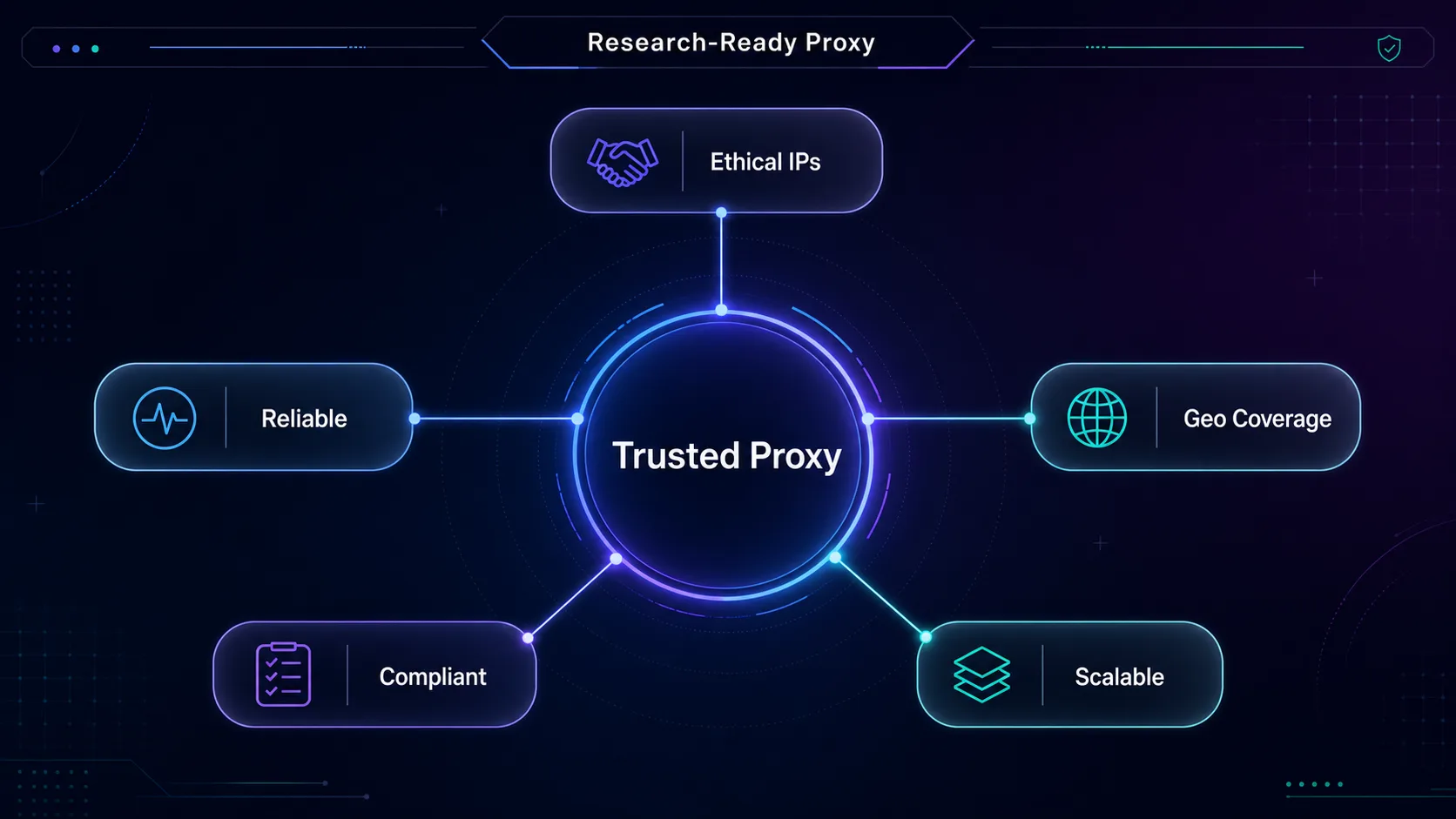
What to Look For in a Research Proxy
1Ethically Sourced IPs
This matters more for research than for anything else. Reputable providers build residential pools from consent-based, opt-in networks where users agree to share bandwidth. For work that may face ethics review, using a provider with transparent, ethical sourcing is part of methodological integrity.
2Reliability and Scale
Your dataset is only as good as your collection. Prioritize providers with large, clean pools and high uptime so a long crawl completes without gaps that would bias your results.
3Geo-coverage
If your study spans regions, you need IPs in each target country — ideally with city-level targeting for localized data.
4Compliance and Support
For institutional work, providers with clear compliance policies, documentation, and responsive support save real headaches — and satisfy the paperwork universities increasingly require.
The Best Proxies for Academic Web Research in 2026
How we picked: we weighed ethical IP sourcing, pool size and cleanliness, uptime, geo-coverage, compliance transparency, and value for research budgets over consumer perks. Where our read is based on public documentation and audits rather than a live study, we say so. A brief disclosure: some links are affiliate links and we may earn a commission — it never changes our rankings.
1Oxylabs

Best for large-scale research. Oxylabs is the enterprise standard, and it fits serious academic work well: a huge, clean IP pool across 195 countries, strong compliance and ethical-sourcing commitments, and a managed Web Scraper API that handles blocks and rendering for you. If you are building a large dataset or running a multi-region study, this is infrastructure that will not fail mid-crawl.
It also publishes research-friendly documentation and offers trials to validate fit. The catch is predictable — it is premium-priced and heavier than a solo student needs. For a funded lab or a large project, the reliability is worth it. See the field in our best residential proxies for scraping roundup.
2Decodo

Best all-rounder. Decodo (formerly Smartproxy) hits the sweet spot of clean residential IPs, an easy dashboard, and pricing that does not punish smaller budgets. With 115M+ IPs across 195+ countries and both rotating and sticky sessions, it handles most research crawls comfortably from a single, approachable plan.
In our experience it is the provider we recommend first to researchers who are not sure what they need. The catch: very large, enterprise-scale studies may eventually want more granular API control. For most graduate projects and mid-sized studies, it is the fastest path to reliable data.
3SOAX

Best for geo-targeted studies. SOAX runs one of the largest clean pools on this list with granular targeting down to country, region, city, and ISP — invaluable for comparative research that depends on where the data is collected. Its filtered, whitelisted IPs keep quality high, which matters when a flaky IP means a gap in your sample.
Both residential and mobile are available, giving flexibility across study designs. Pricing sits in the mid-to-premium band, so it is less a casual pick than a precision instrument. For location-sensitive research, it is exactly the right tool.
4IPRoyal

Best for tight budgets. IPRoyal's non-expiring residential traffic is ideal for research that comes in bursts — you buy a bandwidth balance and it does not vanish at the end of the month, so a semester-long project does not waste unused data. Coverage spans 195 countries with city and ISP targeting at student-friendly prices.
It also offers datacenter options for high-volume open-access scraping. The trade-off is a smaller pool than the giants, so very high-concurrency crawls may see more retries. For individual researchers and modest budgets, it is excellent value.
5Webshare

Best free tier for testing. Webshare offers a genuinely usable free plan and some of the cheapest paid datacenter and residential options around — perfect for piloting a methodology, learning the tools, or running small open-access crawls before committing budget. Native SOCKS5 support adds flexibility.
The trade-off is scale and coverage: a smaller pool across fewer countries makes it a poor fit for large, multi-region studies. Our take: start here to prototype your scraper, then graduate to a larger pool once your data needs grow.
6NodeMaven
Best for long, stable collection sessions. NodeMaven's edge is the longest sticky sessions on the market, so an IP holds steady through a crawl that runs for hours instead of dropping mid-collection. A filter-first approach screens out low-quality IPs before they reach you, which keeps a long research crawl consistent.
Both residential and mobile IPs are available, so you can match trust to each source in your study. The honest caveat: it is newer and smaller than the giants, so raw pool size trails the enterprise names. If dropped sessions are corrupting your data collection, NodeMaven's session stability is worth a look.
7Bright Data

Best for compliance-heavy datasets. Bright Data runs one of the industry's largest networks and is known for its strong compliance framework, know-your-customer checks, and public commitment to ethical data collection — a meaningful reassurance for institutional research that must document its methods. Its dataset and scraping tools can save weeks of engineering.
The trade-off is complexity and cost: it is powerful but can be more than a small project needs, with a steeper learning curve. For large, well-funded studies where compliance documentation matters, it is a strong, defensible choice.
Residential vs Datacenter Proxies for Research
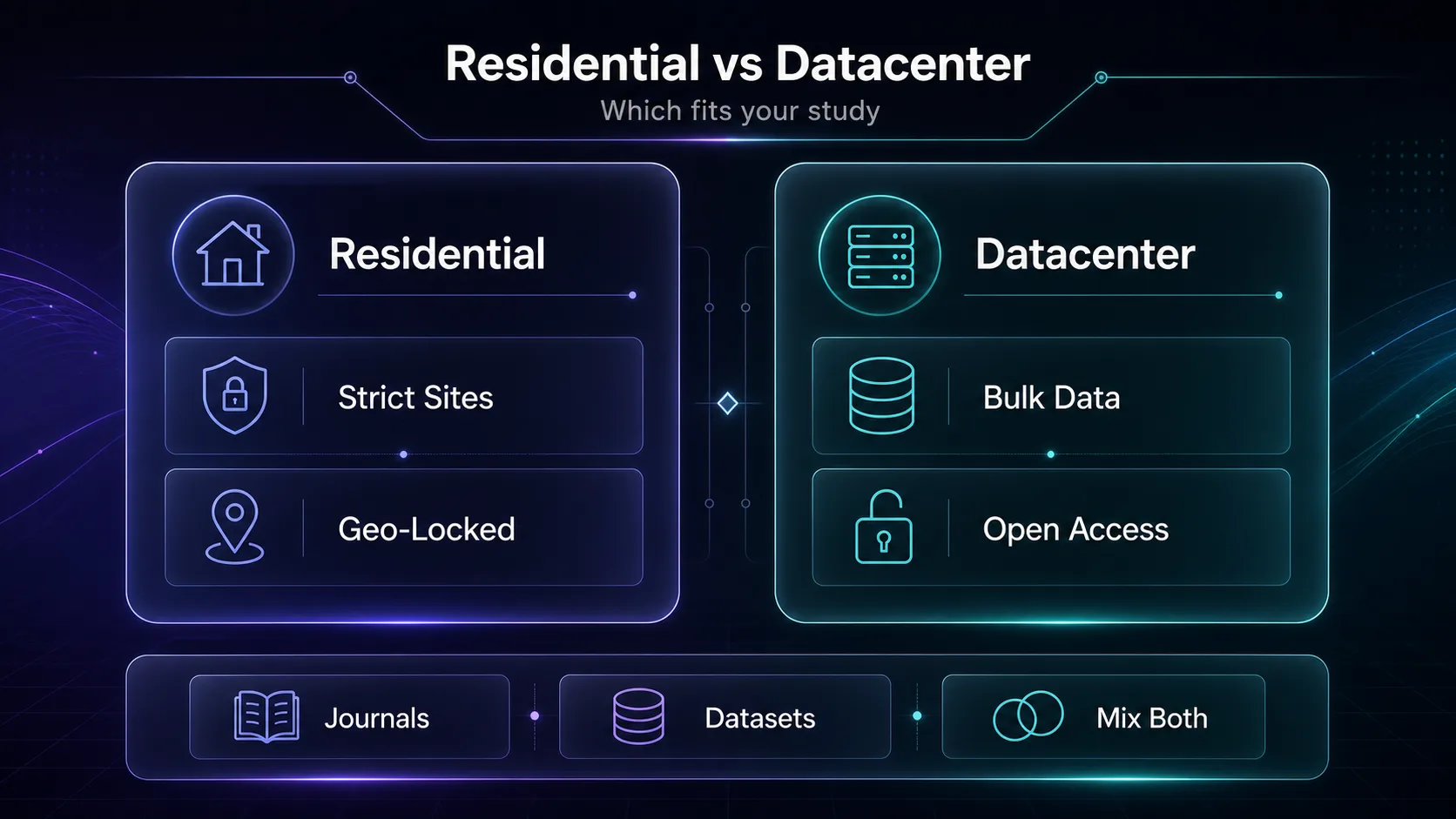
The right proxy type depends on what you are collecting. Here is how they compare for research work:
| Proxy Type | Success on Strict Sites | Speed | Cost | Best For |
|---|---|---|---|---|
| Residential | High | Medium | $$ | Scholarly databases, geo-locked content |
| Datacenter | Low–Medium | Fastest | $ | High-volume open-access crawling |
| ISP (static) | High | Fast | $$$ | Long, stable collection sessions |
Our take: use residential proxies for strict scholarly sites and geo-restricted journals, and cheaper datacenter proxies for high-volume crawling of open-access or public data where blocks are rare. Many research projects use a mix. For the full landscape, see our guide to the types of proxies.
Research Proxy Pricing Compared
Residential proxies are usually billed per gigabyte; datacenter is cheaper and often per IP. Match the model to your data volume. Approximate positioning (always verify current pricing):
| Provider | Pool Size | Model | Best Fit |
|---|---|---|---|
| Oxylabs | 100M+ | Per GB, enterprise | Large-scale studies |
| Decodo | 115M+ | Per GB, plans | All-round value |
| SOAX | 191M+ | Per GB, flexible | Geo precision |
| IPRoyal | 32M+ | Non-expiring GB | Budget, bursty use |
| Webshare | 10M+ | Free + cheap paid | Testing, pilots |
| NodeMaven | 30M+ | Per GB, sticky | Stable sessions |
| Bright Data | 72M+ | Per GB, enterprise | Compliance-heavy work |
Check before you buy: the cheapest per-GB rate is a false economy if the IPs are low quality — you burn data on retries and get a gappy dataset. Weigh IP quality and ethical sourcing, not price alone. Browse live specs in our proxy directory.
The Ethics and Legality of Academic Scraping
This is the section that separates responsible research from a lawsuit, and most proxy roundups pretend it does not exist. Scraping for research is common and often defensible, but it is not a free pass.
Respect the rules of the road. Check a site's robots.txt and terms of service, throttle your requests so you do not degrade the service for others, and identify your crawler honestly where appropriate. Collecting public data is generally more defensible than circumventing paywalls or logins.
Mind personal data and copyright. Scraping personal data can trigger GDPR and similar laws, and many institutions require ethics-board (IRB) approval for it. Copyrighted full texts are not yours to redistribute. When in doubt, collect the minimum, anonymize, and consult your institution's guidelines.
Our take: the proxy is a tool, like a microscope — legitimate and powerful, but your responsibility to use ethically. Use ethically sourced IPs, respect the sites you study, follow your institution's rules, and document your methods. Good ethics and good science are the same discipline.
How to Choose a Research Proxy
1What Is Your Data Volume?
Small pilots run happily on a free tier or pay-as-you-go; large, ongoing studies justify an enterprise plan. Estimate your gigabytes honestly before committing so you neither overpay nor run dry mid-collection.
2Do You Need Specific Locations?
If your study is comparative or region-specific, prioritize geo-coverage and city-level targeting — SOAX and Oxylabs lead here. If not, almost any quality provider works.
3How Much Does Compliance Matter?
Institutional and funded research often needs documented, ethical sourcing and clear compliance policies. Bright Data and Oxylabs are strong on this; it is worth paying for when your methods will be scrutinized.
4What Is Your Budget?
Students and self-funded researchers win with IPRoyal or Webshare; labs and funded projects get better reliability from Oxylabs, NodeMaven, or Bright Data. Match the tier to your actual resources.
Common Mistakes to Avoid in Research Scraping
1Using Free Proxies for Real Data
Free proxies are slow, unstable, often already blocked, and a genuine privacy risk — and a corrupted, incomplete crawl biases your results. For anything that feeds a paper, use a reputable paid provider. The integrity of your dataset depends on it.
2Ignoring Ethical Sourcing
Cheap pools of unknown origin can undermine the ethics of your whole study. For research that may face review, using ethically sourced, consent-based IPs is part of doing the work properly — not an optional extra.
3Crawling Too Aggressively
Hammering a scholarly site with rapid requests can degrade it for others and get you blocked. Throttle, add delays, and be a good citizen — responsible pacing also produces more stable data.
4Skipping robots.txt and Terms
Ignoring a site's stated rules turns a defensible research method into a liability. Read the terms, respect them, and document your compliance so your methods hold up to scrutiny.
5Choosing on Price Alone
The cheapest per-GB rate often means recycled, flagged IPs that waste your bandwidth on failures. Judge by successful requests and data quality, not the sticker price — a gappy dataset costs far more than the savings.
Tips for Better Research Data Collection
- Pilot before you scale. Test your scraper and proxy on a small sample before running the full crawl.
- Throttle and randomize. Human-like delays protect the target site and produce steadier data.
- Log everything. Record timestamps, sources, and IPs so your collection is reproducible and auditable.
- Validate your sample. Check for gaps or bias introduced by blocks and re-collect where needed.
- Document your methods. Note the provider, sourcing, and compliance steps — reviewers and reproducibility both demand it.
Frequently Asked Questions
Conclusion
The best proxy for academic research is the one that fits your study and your ethics. For large, funded work, Oxylabs and Bright Data lead on scale and compliance. Decodo is the best all-rounder, SOAX excels at geo-targeted studies, NodeMaven at session stability, and IPRoyal and Webshare keep costs down for students and pilots.
Whichever you choose, remember that research carries a higher bar: use ethically sourced IPs, respect the sites you study, throttle your crawls, mind personal data and copyright, and document your methods. Get the tool and the ethics right, and your data collection becomes a strength your reviewers will respect rather than question.
Ready to start? Compare research-grade providers in our proxy directory, line two up with our comparison tool, or learn the fundamentals in our guide to how proxies work. Pilot small, collect responsibly, and scale what works.
Keep Reading
More articles you might enjoy