Best Residential Proxies for Web Scraping in 2026
Residential proxies are the gold standard for web scraping — they carry real ISP-assigned IPs that defeat even the most aggressive bot detection. We tested and ranked the 7 best residential proxy providers for scraping in 2026, covering success rates, pool sizes, pricing, and which targets each handles best.
![Best Residential Proxies for Web Scraping in [year]](/_next/image?url=https%3A%2F%2Fproxyhorizon.com%2Fcdn%2Fblog-images%2Fcv55a31orh_1773739804545.webp&w=3840&q=75)
Web scraping has never been more valuable, or more aggressively blocked. In 2026, over 73% of the web’s top 10,000 sites deploy active bot detection, with platforms like Cloudflare, Akamai, and PerimeterX raising the bar higher every quarter. Generic datacenter IPs get blocked within minutes on most major targets.
This is why residential proxies have become the backbone of professional web scraping. They route your requests through real devices on real ISP networks, indistinguishable from a human browsing the web. The result: dramatically higher success rates, fewer CAPTCHAs, and consistent access to even the most bot-hardened websites.
But not all residential proxy providers are equal. Pool quality, rotation logic, geographic coverage, and pricing models vary enormously. We ran real-world tests across e-commerce sites, search engines, and social platforms to bring you the 7 best residential proxies for web scraping in 2026.
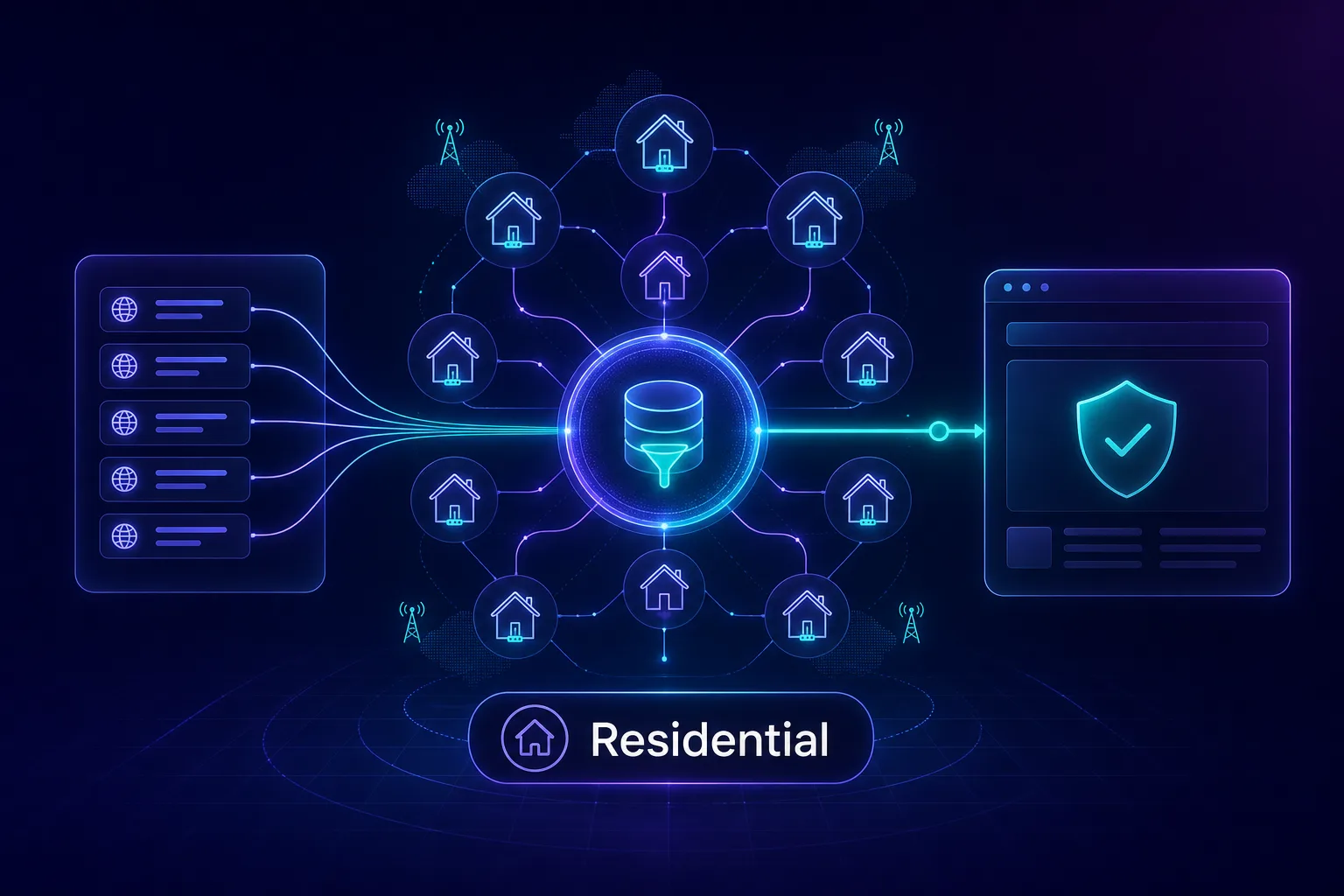
- Residential proxies use IPs from real home connections, so sites treat them as ordinary users rather than bots.
- They are the practical default for scraping defended targets where datacenter IPs get blocked on contact.
- Billing is per gigabyte, so managing bandwidth is the main lever on your total cost.
- Pair them with sensible rotation, realistic pacing, and proper retry handling to keep success rates high.
What Are Residential Proxies?
Residential proxies are IP addresses assigned by internet service providers (ISPs) to real homeowners and mobile users. When you route a scraping request through a residential proxy, the target website sees a legitimate ISP-assigned IP, the same kind of IP a real user in that location would have.
This stands in sharp contrast to datacenter proxies, which originate from cloud servers and are trivially identifiable as non-human traffic by modern anti-bot systems. Residential IPs carry significantly higher trust scores with fraud detection systems, making them far more effective for scraping heavily protected websites.
1Residential vs. Datacenter Proxies for Scraping
Factor | Residential Proxies | Datacenter Proxies |
|---|---|---|
Success Rate on Protected Sites | 85–99% | 30–60% |
Average Speed | Moderate (100–500ms) | Fast (10–100ms) |
Detection Risk | Very Low | High |
Cost per GB | $2–$15/GB | $0.10–$2/IP |
Best For | E-commerce, social media, search engines | Public APIs, basic scraping |
IP Pool Size | Millions of IPs | Thousands to hundreds of thousands |
Best Residential Proxies for Web Scraping in 2026
The following providers were evaluated based on: IP pool size and diversity, success rates on real scraping targets, rotation options, pricing transparency, and quality of developer tooling.
1Bright Data

Bright Data operates the world’s largest residential proxy network with over 72 million real IPs across 195 countries. For web scraping, this scale matters enormously, with such a vast pool, you virtually never hit the same IP twice, keeping your scraping sessions fresh and undetectable across long-running jobs.
Their Scraping Browser product is particularly powerful: it embeds full browser fingerprinting management, automatic CAPTCHA handling, and JavaScript rendering directly into the proxy layer. For teams who need to scrape JavaScript-heavy SPAs or sites with aggressive bot detection, Scraping Browser eliminates entire classes of infrastructure problems.
Pricing starts at $8.40/GB for pay-as-you-go, dropping to $2.94/GB at higher tiers. The Web Unlocker product also offers a success-rate guarantee with automatic retries and proxy rotation built in.
Best for: Enterprise scraping, e-commerce data, search engine results, social media data collection.
2Oxylabs

Oxylabs is the go-to for organizations running continuous, high-volume scraping operations. Their residential network spans over 100 million IPs with advanced AI-powered rotation that automatically adapts to target site behavior, reducing blocks without manual tuning.
Their Web Scraper API is a standout feature for scraping teams: it handles browser rendering, CAPTCHA solving, and proxy management in a single endpoint, returning structured data without you managing any proxy infrastructure. For price intelligence, travel fare scraping, or financial data collection, Oxylabs is the most reliable enterprise option on the market.
Residential proxy plans start at $8/GB, with dedicated account managers and SLA guarantees at enterprise tiers.
Best for: Large-scale data pipelines, price monitoring, market intelligence, travel and finance data.
3Smartproxy
Smartproxy delivers exceptional value for small-to-medium scraping operations. Their residential pool covers 65+ million IPs across 195+ countries, with both rotating and sticky session options. For developers building scrapers on a budget, Smartproxy’s pricing, starting at $7/GB, is among the most competitive at this pool quality level.
Their X Browser integration and well-documented API make it easy to integrate into Python scrapers using Scrapy, Playwright, or Puppeteer. Smartproxy’s dashboard includes real-time bandwidth tracking and per-target success rate monitoring, which is invaluable for optimizing long scraping jobs without burning through bandwidth on failed requests.
Best for: Developers, small scraping teams, SEO data collection, e-commerce monitoring.
4Decodo

Decodo excels at high-frequency rotating residential scraping, assigning a fresh IP for every request from their pool of over 40 million residential IPs. This makes it ideal for scraping at high concurrency where IP freshness directly impacts success rates.
Their Site Unblocker tool automatically handles JavaScript rendering and adaptive fingerprinting for the most stubborn targets, including Google, Amazon, and Booking.com. Pricing is per-GB with no minimum commitment, making Decodo exceptionally flexible for variable-volume workloads where you do not want to pay for unused bandwidth.
Best for: High-concurrency scrapers, SERP scraping, per-request rotation workloads.
5Nimbleway
Nimbleway takes a fundamentally different approach to residential proxy scraping. Rather than a raw proxy network, they offer a fully managed scraping infrastructure where AI handles blocking detection, adaptive rotation, and retry logic automatically. Their Nimble Browser product runs headless Chromium through their residential network with real-time fingerprint randomisation built in.
For development teams who want scraping infrastructure without the DevOps overhead of managing proxy rotation, CAPTCHA pipelines, and browser-fingerprinting layers, Nimbleway is a category-defining product in 2026. Success rates on Tier-1 retail and social sites routinely exceed 95%.
Best for: Teams seeking managed scraping infrastructure, headless browser scraping, maximum success rates.
6SOAX

SOAX provides one of the most granular geo-targeting systems in the residential proxy market, offering filtering by country, region, city, and even mobile carrier. With a pool of over 155 million IPs, SOAX is exceptional for localization testing, geo-specific price scraping, and competitive intelligence research that requires authentic local IP perspectives.
Their clean IP guarantee means every IP in their network has been verified as non-abused before being added to the pool, dramatically reducing the chance of hitting pre-banned IPs. SOAX supports both HTTP/HTTPS and SOCKS5, with plans starting from $6/GB at smaller tiers.
Best for: Geo-targeted scraping, localized content research, ad verification, price localization.
7Infatica

Infatica offers one of the lowest entry prices for residential proxies without sacrificing meaningful pool coverage. Their network spans over 10 million IPs across 100+ countries, making them well-suited for scraping jobs that do not require Bright Data-scale pools but still need genuine residential IPs to bypass anti-bot measures.
Plans start at $3.99/GB, making Infatica an excellent gateway for solo developers and startups testing residential proxy scraping before committing to higher-tier providers. HTTP, HTTPS, and SOCKS5 are all supported, with both rotating and sticky session modes available.
Best for: Startups, individual developers, cost-sensitive scraping projects, small-scale data collection.
How to Choose a Residential Proxy for Web Scraping
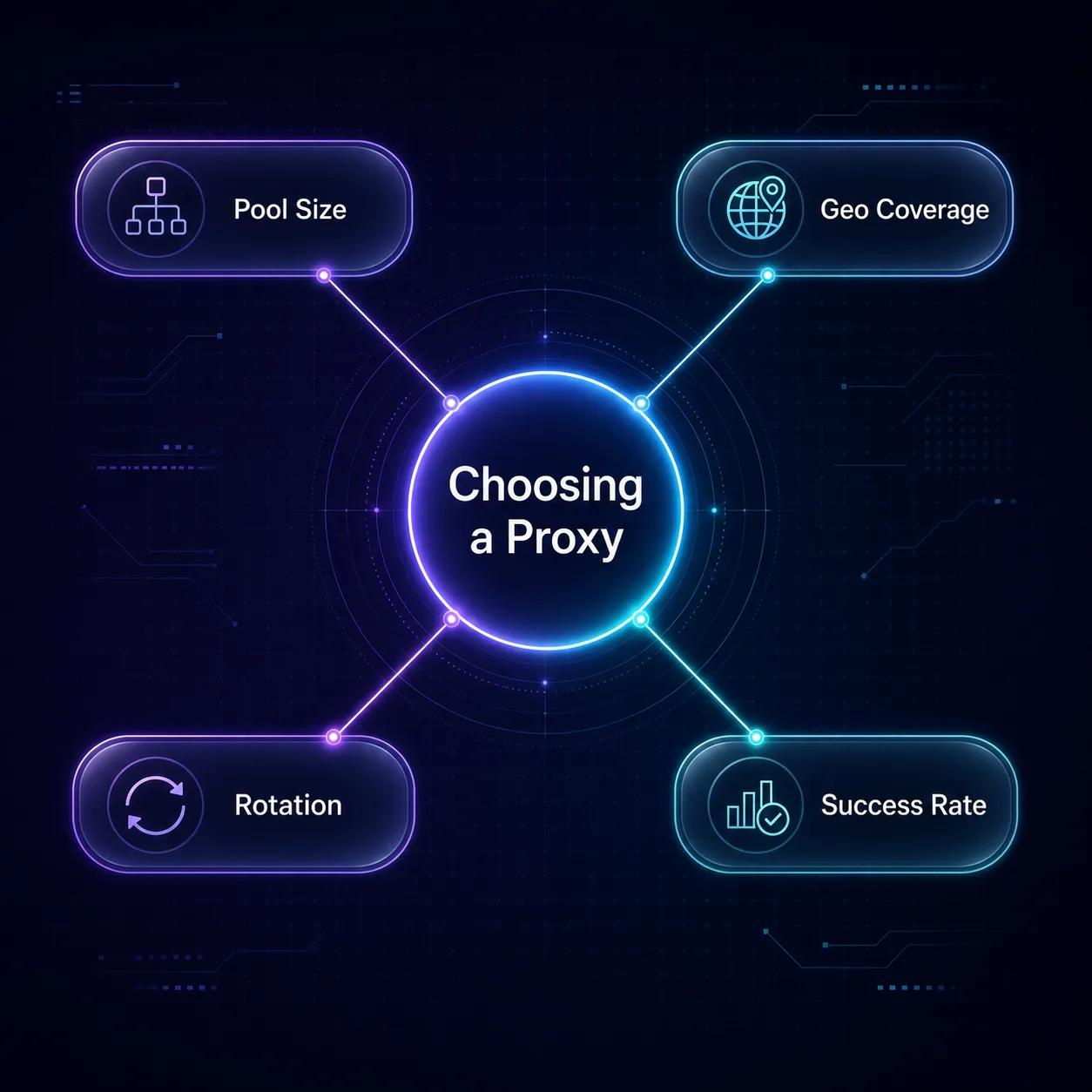
Choosing the right residential proxy is not just about price per GB. Here are the critical factors to evaluate before committing to a provider:
Factor | Why It Matters | What to Look For |
|---|---|---|
Pool Size | Larger pools mean less IP reuse, lower block rates | 40M+ IPs for heavy scraping; 10M+ for moderate |
Geo Coverage | Scraping geo-restricted content requires local IPs | 100+ countries; city-level targeting for localization |
Rotation Options | Per-request rotation is best for high-volume scraping | Both rotating and sticky session support |
Success Rate | Failed requests waste bandwidth and money | 85%+ on protected targets; prefer providers with retry logic |
Pricing Model | Per-GB is flexible; subscription can be cheaper at volume | Match to your bandwidth consumption pattern |
Protocol Support | SOCKS5 is required for some scrapers (Scrapy, curl) | HTTP, HTTPS, and SOCKS5 all supported |
Web Scraping Best Practices with Residential Proxies
Two architectural decisions shape everything else: how you queue work, covered in how large-scale crawlers manage request queues, and whether you carry session state, covered in stateless vs stateful scraping.
Even with premium residential proxies, poor scraping practices can quickly exhaust your budget and trigger blocks. Follow these professional techniques to maximize efficiency:
Rotate IPs per request, not per session. For most scraping targets, assigning a fresh residential IP to every HTTP request provides the lowest fingerprint consistency and the highest success rate. Only use sticky sessions when you need to maintain a logged-in state or follow a multi-step flow.
Throttle your request rate. Even residential IPs can trigger bot detection if they generate unnaturally fast request patterns. Implement random delays between 1.5 and 4 seconds to mimic human browsing cadence, especially on retail and social targets.
Match your User-Agent to your IP. A residential IP paired with a headless Chrome user-agent with mismatched browser fingerprints is a common detection signal. Use providers that auto-manage headers and TLS fingerprinting, or set realistic, randomised headers manually in your scraper.
Monitor your success rate per domain. Use your provider’s dashboard or a custom metrics layer to track success rates by target. If a specific domain drops below 70%, it is a signal to switch rotation strategy, adjust request headers, or upgrade to a managed scraping solution like Bright Data’s Web Unlocker.
For a broader look at proxy types and their ideal use cases, see our full proxy provider directory and our guide on best datacenter proxies if speed is your primary requirement over anonymity.
Residential Proxy Pricing Comparison
Provider | Pool Size | Starting Price | Countries | Best For |
|---|---|---|---|---|
Bright Data | 72M+ IPs | $8.40/GB | 195 | Enterprise, full-stack scraping |
Oxylabs | 100M+ IPs | $8/GB | 195 | High-volume, APIs, SLA |
Smartproxy | 65M+ IPs | $7/GB | 195+ | Value, developers |
Decodo | 40M+ IPs | $7/GB | 195+ | Rotating, flexibility |
Nimbleway | Managed | Custom | Global | AI-managed, high success rate |
SOAX | 155M+ IPs | $6/GB | 195 | Geo-targeting, clean IPs |
Infatica | 10M+ IPs | $3.99/GB | 100+ | Budget, startups |
Common Mistakes to Avoid When Scraping with Residential Proxies
Most blocks trace back to signals beyond the IP, which we break down in how browser automation traffic differs from normal HTTP requests. For recovery patterns, see handling proxy timeouts and errors.
Even with a premium pool, a handful of recurring mistakes quietly inflate costs and trigger blocks. Avoid these five and both your success rate and your budget will improve.
1Reusing the Same IP for Too Many Requests
Buying a million-IP pool and then hammering one address for thousands of requests defeats the entire purpose of residential proxies. The target still sees concentrated traffic from a single IP and flags it. Configure proper per-request rotation, or build your own logic following our guide on building a rotating proxy script in Python, so your footprint stays distributed.
2Treating Every Target Like It Runs Cloudflare
Over-engineering is real waste. Many sites have light or no bot protection, and paying premium residential rates plus full browser rendering for them burns money. Reserve your heaviest tooling for genuinely hard targets, our walkthrough on how to bypass Cloudflare when scraping shows when that firepower is actually warranted.
3Ignoring Bandwidth Burned on Failed Requests
Every blocked request still consumes the bandwidth you paid for, so a low success rate silently doubles your effective cost per page. Benchmark a provider on your real targets before committing, our guide to testing proxy speed, latency, and success rate shows how to measure cost-per-success, not just headline price.
4Using Residential IPs When ISP or Datacenter Would Do
Residential proxies are the most expensive type per gigabyte, and they are overkill for static account work or lightly defended sites. For tasks needing a fixed, persistent IP, static ISP proxies are faster and cheaper. Match the proxy type to the job instead of defaulting to residential for everything.
5Skipping Fingerprint and Header Hygiene
A pristine residential IP paired with a default scraper user-agent and identical headers on every request is still an obvious bot. Anti-bot systems score IP and fingerprint together. Rotate realistic headers and user-agents alongside your IPs, the fundamentals covered in our web scraping primer apply to every job.
Frequently Asked Questions
Conclusion
Residential proxies are no longer optional for professional web scraping, they are the foundation. With bot detection systems becoming more sophisticated every quarter, the gap in success rates between residential and datacenter IPs on protected targets continues to widen.
Our top picks for the best residential proxies for web scraping in 2026:
Bright Data: Best overall, largest pool, most comprehensive tooling
Oxylabs: Best for enterprise-scale continuous scraping pipelines
Smartproxy: Best value for developers and small teams
Decodo: Best for high-frequency per-request rotation
Nimbleway: Best for AI-managed, zero-DevOps scraping
SOAX: Best for granular geo-targeting and clean IP pools
Infatica: Best budget option for startups and solo developers
Ready to start scraping? Browse our full residential proxy directory to compare all providers side-by-side, or use our proxy comparison tool to find the best match for your specific scraping stack and budget.
![The Best Data Extraction APIs to Try in [year]](/_next/image?url=https%3A%2F%2Fproxyhorizon.com%2Fcdn%2Fblog-images%2Fbest-data-extraction-apis-1-mufdevwh.webp&w=3840&q=75)
![Best SERP APIs ([year]): Compared for Accuracy, Pricing & AI](/_next/image?url=https%3A%2F%2Fproxyhorizon.com%2Fcdn%2Fblog-images%2Fbest-serp-apis-1-mufdet7y.webp&w=3840&q=75)
![How to Add an MTProto Proxy to Telegram ([year])](/_next/image?url=https%3A%2F%2Fproxyhorizon.com%2Fcdn%2Fblog-images%2Fhow-to-add-mtproto-proxy-telegram-1-mu9ha99k.webp&w=3840&q=75)