Why Web Scraping Needs Proxies — Complete 2026 Guide
Web scraping needs proxies to avoid IP bans, unlock geo-restricted data, and beat anti-bot systems. Here is exactly why, and how to choose the right type.
![Why Web Scraping Needs Proxies — Complete [year] Guide](/_next/image?url=https%3A%2F%2Fmccjemjghcyvrervacap.supabase.co%2Fstorage%2Fv1%2Fobject%2Fpublic%2Fblog-images%2Fwhy-web-scraping-needs-proxies-1-mqyw3k6u.webp&w=3840&q=75)
Try to scrape a major website at any real scale from a single IP address and you'll hit a wall within minutes. The site notices dozens of requests from one machine, flags it as a bot, and serves up a 403, a CAPTCHA, or a permanent ban. Without proxies, serious data collection simply doesn't happen.
The numbers explain why. An estimated 47% of all internet traffic is automated, and sophisticated anti-bot systems now block a large share of unprotected scraping attempts before the first page even loads. Sites like Amazon and Google can rate-limit a raw IP after as few as 10–20 rapid requests.
This guide explains exactly why web scraping depends on proxies — from dodging IP bans to unlocking geo-restricted data — and how to pick the right type for your project. If you've ever wondered why every scraping tutorial insists on a proxy, this is the complete answer.
What a Proxy Actually Does for a Scraper
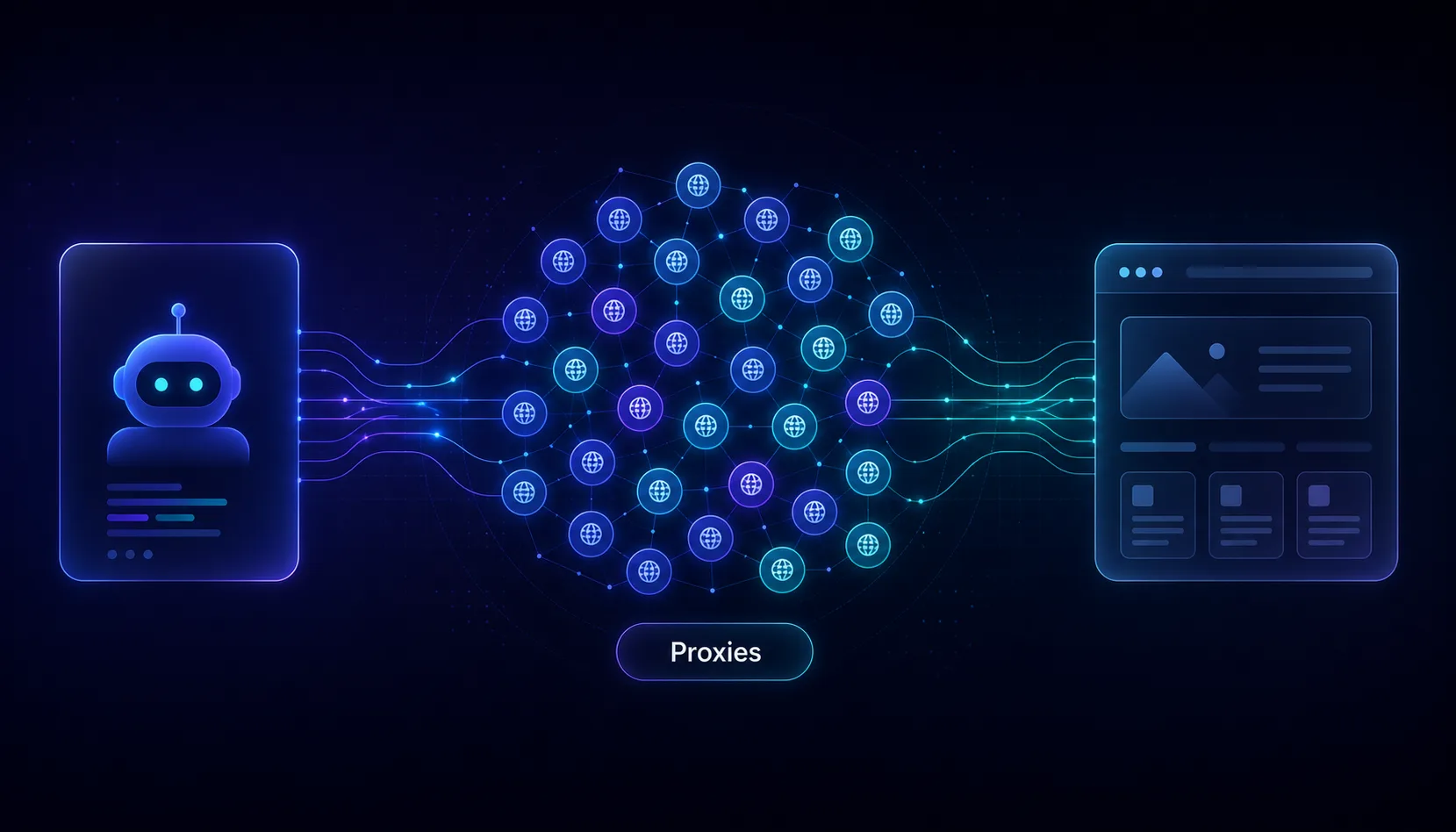
A proxy sits between your scraper and the target website, forwarding your requests through a different IP address. The target sees the proxy's IP, not yours — and when you rotate through a pool of thousands of IPs, your traffic looks like many separate visitors instead of one aggressive bot.
That single property — masking and distributing your origin — solves the core problem of scraping at scale. Anti-bot systems judge traffic largely by IP behavior: how many requests come from one address, how fast, and from where. Spread those requests across many IPs and you stay under the radar.
Proxies also let you control where your requests appear to originate, which is essential for collecting accurate, location-specific data. Without that control, you're limited to one IP, one location, and one very short scraping session before you're blocked.
Reason 1: Avoiding IP Bans and Rate Limits
The most fundamental reason scraping needs proxies is to avoid getting blocked. Websites monitor request frequency per IP, and once you cross an invisible threshold, they throttle or ban you outright. A single IP can rarely make more than a few hundred requests before triggering defenses.
By rotating requests across a large proxy pool, each individual IP makes only a handful of requests, staying well below ban thresholds. This is the difference between scraping 10 pages and scraping 10 million. For sustained large-scale scraping, IP rotation isn't optional — it's the foundation.
Residential and mobile proxies are especially effective here because their IPs belong to real consumer devices, making them far harder to distinguish from genuine users than datacenter ranges.
Reason 2: Bypassing Geo-Restrictions
Vast amounts of web data are location-dependent. Pricing, product availability, search results, and ad campaigns all change based on the visitor's country or city. A scraper running from a single location sees only one version of the truth.
Proxies with IPs in specific countries let you view a site exactly as a local user would. Want to compare Nike's prices in the US, Germany, and Japan simultaneously? Route each request through a proxy in the relevant country and collect all three localized datasets in parallel.
This geo-targeting capability is indispensable for price monitoring, ad verification, and market research — use cases that are impossible without proxies covering the regions you care about.
Reason 3: Collecting Accurate, Localized Data
Beyond simple access, proxies ensure the data you collect is representative. Search engines personalize results by location and IP reputation, so scraping Google from one datacenter IP gives a skewed, non-representative snapshot.
City-level residential proxies let you capture exactly what a real user in that market sees — the correct local search rankings, the right currency, the actual in-stock status. For SEO monitoring and competitive intelligence, that accuracy is the entire point of the exercise.
Without geographically diverse proxies, your dataset is biased toward wherever your server happens to live, undermining every decision built on top of it.
Reason 4: Defeating Anti-Bot and Fingerprinting Systems
Modern sites deploy services like Cloudflare, DataDome, and PerimeterX that score every visitor on IP reputation, request headers, and behavioral signals. A flagged datacenter IP is rejected before your scraper even renders the page.
High-quality proxies with clean IP reputation are the first layer of defense against these systems. Paired with proper headers and request pacing, residential proxies dramatically raise your success rate against protected targets. Our guide on bypassing Cloudflare when scraping goes deeper on this exact challenge.
Proxies alone won't beat every anti-bot system, but without them you don't even get to the starting line on protected sites.
Proxy Types for Web Scraping Compared
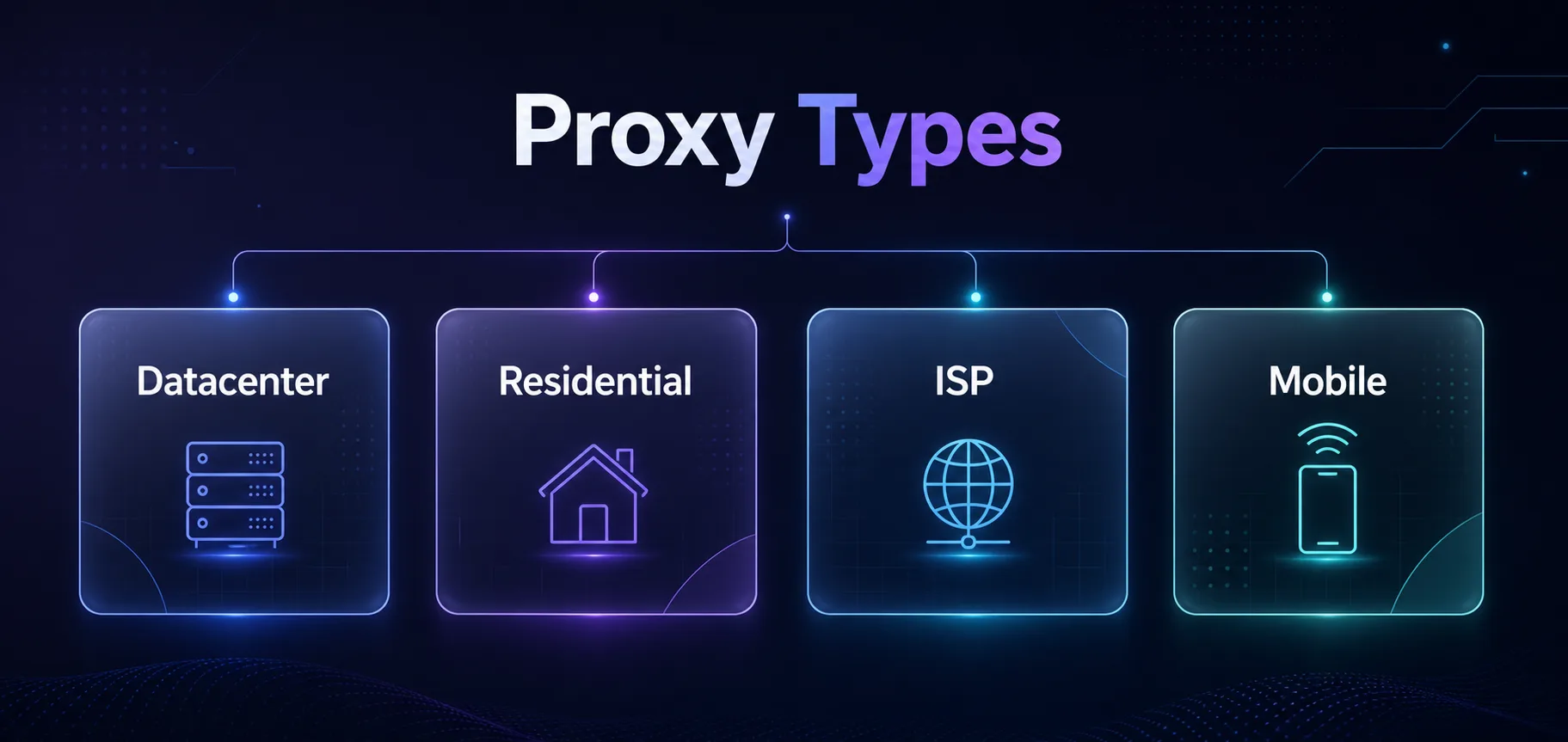
Not all proxies suit every scraping job. The four main types trade off speed, cost, and block-resistance differently. This table maps each to its best use case.
| Proxy Type | Speed | Block Resistance | Cost | Best For |
|---|---|---|---|---|
| Datacenter | Very fast | Low | Cheapest | Unprotected sites, high volume |
| Residential | Moderate | High | Mid–high | Protected sites, geo-targeting |
| ISP (Static Residential) | Fast | High | High | Long sessions, account work |
| Mobile | Slower | Highest | Most expensive | Social media, toughest targets |
Most scraping projects use residential proxies as their default because they balance block-resistance with cost, falling back to datacenter IPs for easy, high-volume targets.
Best Proxy Providers for Web Scraping
The right provider makes the difference between a crawl that runs for weeks and one that dies on day one. These four combine clean IP pools, broad geo-coverage, and scraping-friendly features — explore more in our proxy provider directory.
1Decodo

Best for teams that want a high success rate without enterprise pricing, Decodo pairs a 115M+ IP pool with 99.99% uptime and granular city-level targeting. It handles both residential and datacenter needs from one dashboard.
Its sticky-session controls and per-request metrics make it easy to tune scraping jobs. For mixed workloads spanning easy and protected targets, it's one of the most balanced choices available.
2Oxylabs

Built for enterprise-scale scraping, Oxylabs runs a 102M+ residential pool across 195 countries with top-tier IP reputation. It excels precisely where cheaper pools fail — on heavily protected, anti-bot-defended targets.
Expect a premium price in exchange for the highest success rates and dedicated scraping APIs. If your project hits Cloudflare or DataDome sites at scale, Oxylabs sets the benchmark.
3IPRoyal

Ideal for budget-conscious scrapers, IPRoyal offers non-expiring residential traffic so unused data never goes to waste between jobs. Its 32M+ pool spans 195 countries with solid sub-second response times.
The pay-as-you-go model lets small teams scale spending with their actual usage. For freelancers and startups validating a scraping pipeline, it's a frequent winner on price-per-success.
4Smartproxy
Great value for growing projects, Smartproxy delivers a 55M+ residential pool with an approachable dashboard and strong documentation. It's a popular bridge between cheap datacenter IPs and premium enterprise tools.
Its ready-made scraping endpoints reduce setup time considerably. For teams that want reliable residential coverage without an enterprise contract, it's a dependable pick.
What Happens If You Scrape Without Proxies
Skipping proxies doesn't just risk a ban — it caps what's possible. The table below contrasts scraping with and without a proxy layer so the trade-off is concrete.
| Factor | Without Proxies | With Proxies |
|---|---|---|
| Request volume | Dozens before a ban | Millions across rotating IPs |
| Geo-coverage | One location only | Any country or city |
| Block rate | Very high | Low with quality pools |
| Data accuracy | Location-biased | Representative and localized |
For a one-off scrape of a few public pages, you may get away without proxies. For anything recurring, large, or commercially important, they're a hard requirement.
Common Mistakes to Avoid When Using Proxies for Scraping
Adding proxies solves the access problem, but using them poorly creates new ones. Avoid these frequent errors.
1Using Cheap Datacenter IPs on Protected Sites
Datacenter proxies are fast and cheap, but their IP ranges are easily identified and blocked by anti-bot systems. Pointing them at Cloudflare-protected or e-commerce targets guarantees high block rates. Match the proxy type to the target's defenses — reach for residential or mobile on protected sites.
2Not Rotating IPs Frequently Enough
Buying a proxy pool but reusing the same IP for thousands of requests defeats the purpose. The target still sees concentrated traffic from one address and bans it. Configure proper rotation — a new IP per request or per short session — to actually distribute your footprint.
3Ignoring Request Headers and Fingerprints
Proxies mask your IP, but a default scraping user-agent and identical headers on every request still scream "bot." Anti-bot systems combine IP and fingerprint signals. Rotate realistic headers and user-agents alongside your IPs, or even quality proxies won't save you.
4Scraping Too Aggressively
Even with a huge pool, hammering a site with maximum concurrency invites detection and can overload the target. Add delays, randomize timing, and respect reasonable rate limits. Mimicking human-like pacing keeps your IPs clean and your success rate high.
5Choosing Quantity Over Quality
A massive pool of dirty, recycled IPs performs worse than a smaller pool of clean ones. Cheap providers often resell abused IPs already on blocklists. Prioritize IP reputation and uptime over headline pool-size numbers when choosing a provider.
Best Practices for Proxy-Powered Scraping
- Match proxy type to target difficulty — datacenter for easy sites, residential or mobile for protected ones, to balance cost and success.
- Rotate IPs and headers together — a fresh IP with a stale fingerprint still gets flagged; vary both for realistic traffic.
- Throttle and randomize timing — human-like pacing keeps IPs clean and avoids overloading targets.
- Build retry logic that rotates on failure — switch to a new IP on a block instead of re-hitting a banned one. Our rotating proxy script guide shows how.
- Test and compare providers on your real targets — line them up in our comparison tool before committing budget.
How to Choose the Right Proxy for Your Scraping Project
The decision comes down to three questions. First, how protected are your targets? Lightly defended sites work fine with cheap datacenter IPs; Cloudflare-grade defenses demand residential or mobile pools.
Second, do you need specific geographies? If your data is location-sensitive, prioritize a provider with strong coverage in your target countries and city-level targeting. Third, what's your volume and budget? Pay-as-you-go residential suits small projects, while enterprise contracts make sense at millions of requests.
When in doubt, start with residential proxies from a reputable provider and a small plan, benchmark them on your real targets, then scale. Pairing the right pool with the techniques in our web scraping with Python guide gives most projects everything they need.
Real-World Scraping Use Cases That Depend on Proxies
The case for proxies becomes concrete when you look at the industries that run on scraped data. Each of these workflows collapses the moment a single IP gets blocked, which is exactly why proxies are non-negotiable in production.
Price intelligence teams track competitor pricing across thousands of products and multiple countries in near real time — impossible without geo-distributed, rotating IPs that see each market's local prices. SEO and SERP monitoring tools scrape search rankings from specific cities, where even a slightly wrong location skews every result. Ad verification platforms confirm that campaigns display correctly to real users in target regions, which requires residential IPs in those exact locations.
Travel aggregators pull fares and availability that change by point of sale, market researchers gather reviews and product data at volume, and brand-protection teams hunt counterfeit listings across marketplaces. In every case the common thread is the same: meaningful scale and accuracy demand a proxy pool, not a single connection. The business value lives in the breadth of data, and breadth is exactly what proxies make possible.
Frequently Asked Questions
Conclusion: Proxies Are the Backbone of Scraping
Web scraping needs proxies for one simple reason: without them, you're a single, easily-blocked IP that can't reach scale, can't see location-specific data, and can't get past modern anti-bot defenses. Proxies turn one fragile connection into thousands of resilient, geographically diverse ones.
Choose the right type for your targets — datacenter for easy, high-volume sites, residential or mobile for protected ones — rotate IPs and headers together, and pace your requests like a human. Get those fundamentals right and the difference in success rate is night and day.
Ready to build a scraper that actually runs? Start with a clean, high-uptime pool from our proxy directory, compare the top names in our side-by-side tool, and dig into the best options in our roundup of residential proxies for web scraping.
![Best Cloro.dev Alternatives for Search API and AI Agents ([year])](/_next/image?url=https%3A%2F%2Fproxyhorizon.com%2Fcdn%2Fblog-images%2Fbest-cloro-alternatives-1-muhiipeo.webp&w=3840&q=75)
![Best Firecrawl Alternatives to Try in [year]](/_next/image?url=https%3A%2F%2Fproxyhorizon.com%2Fcdn%2Fblog-images%2Fbest-firecrawl-alternatives-1-muhiimue.webp&w=3840&q=75)
![The Best Data Extraction APIs to Try in [year]](/_next/image?url=https%3A%2F%2Fproxyhorizon.com%2Fcdn%2Fblog-images%2Fbest-data-extraction-apis-1-mufdevwh.webp&w=3840&q=75)