IPv4 vs IPv6 Proxies: Architecture, Compatibility & Performance (2026)
IPv4 vs IPv6 proxies compared: how the two addressing systems differ in architecture, why compatibility matters more than price, and which one to choose for your use case.
Browse any proxy provider’s pricing page and you will eventually hit a fork in the road: IPv4 proxies at one price, IPv6 proxies at a small fraction of it. The temptation is obvious. Why pay several dollars per IP when you can get IPv6 addresses for pennies, or by the thousand?
The answer is the single most important thing to understand about this comparison, and most guides bury it. IPv6 proxies are cheap because the addresses are effectively unlimited, but a large share of the internet still cannot accept a connection from one. Buying the wrong type is the difference between a working scraper and one that fails on every target.
This guide breaks down IPv4 vs IPv6 proxies properly: how the two protocols actually differ in architecture, where the compatibility wall sits, how they compare on real-world performance and trust, and exactly which one to choose for your use case. Let us get into it.
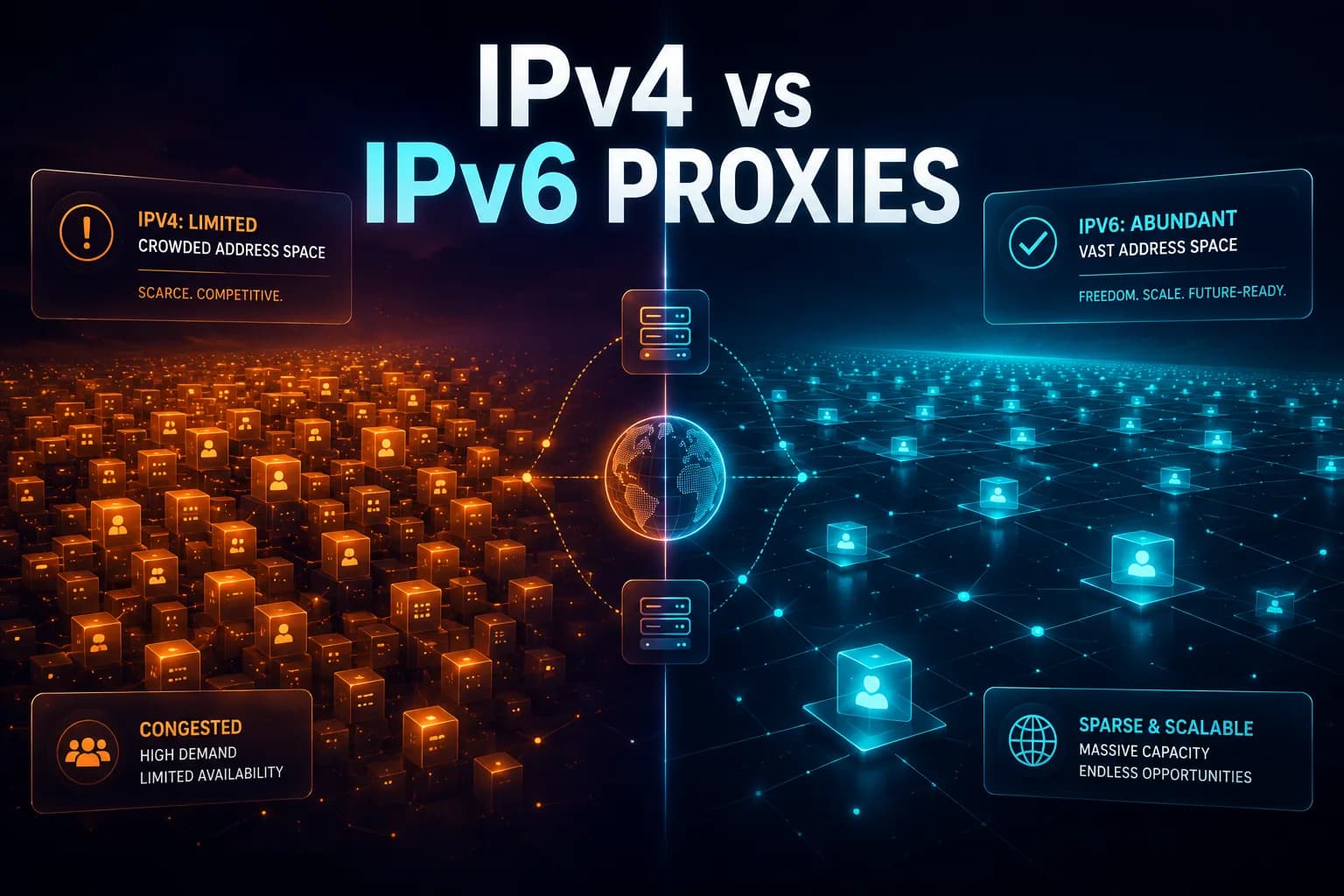
- IPv4 uses 32-bit addresses (about 4.3 billion, now exhausted), while IPv6 uses 128-bit addresses in a practically unlimited pool.
- That scarcity is why IPv4 proxies cost dollars per IP and IPv6 proxies cost a tiny fraction of that.
- Compatibility is the deciding factor: many major sites still do not accept IPv6 connections, so an IPv6 proxy simply cannot reach them.
- Choose IPv4 for general use, account work, and most scraping. Choose IPv6 only for high-volume tasks against targets you have confirmed support it.
IPv4 vs IPv6 Proxies: Quick Comparison
Here is the short version before we go deeper.
| Factor | IPv4 Proxies | IPv6 Proxies |
|---|---|---|
| Address size | 32-bit (about 4.3 billion total) | 128-bit (practically unlimited) |
| Availability | Scarce and exhausted | Effectively unlimited |
| Cost per IP | High | Very low |
| Site compatibility | Universal | Partial, many sites unreachable |
| Trust and reputation | Established, well understood | Often blocked in bulk by subnet |
| Raw speed | Excellent | Excellent, sometimes marginally faster |
| Best for | Almost everything | High-volume tasks on IPv6-ready targets |
The Architecture Difference
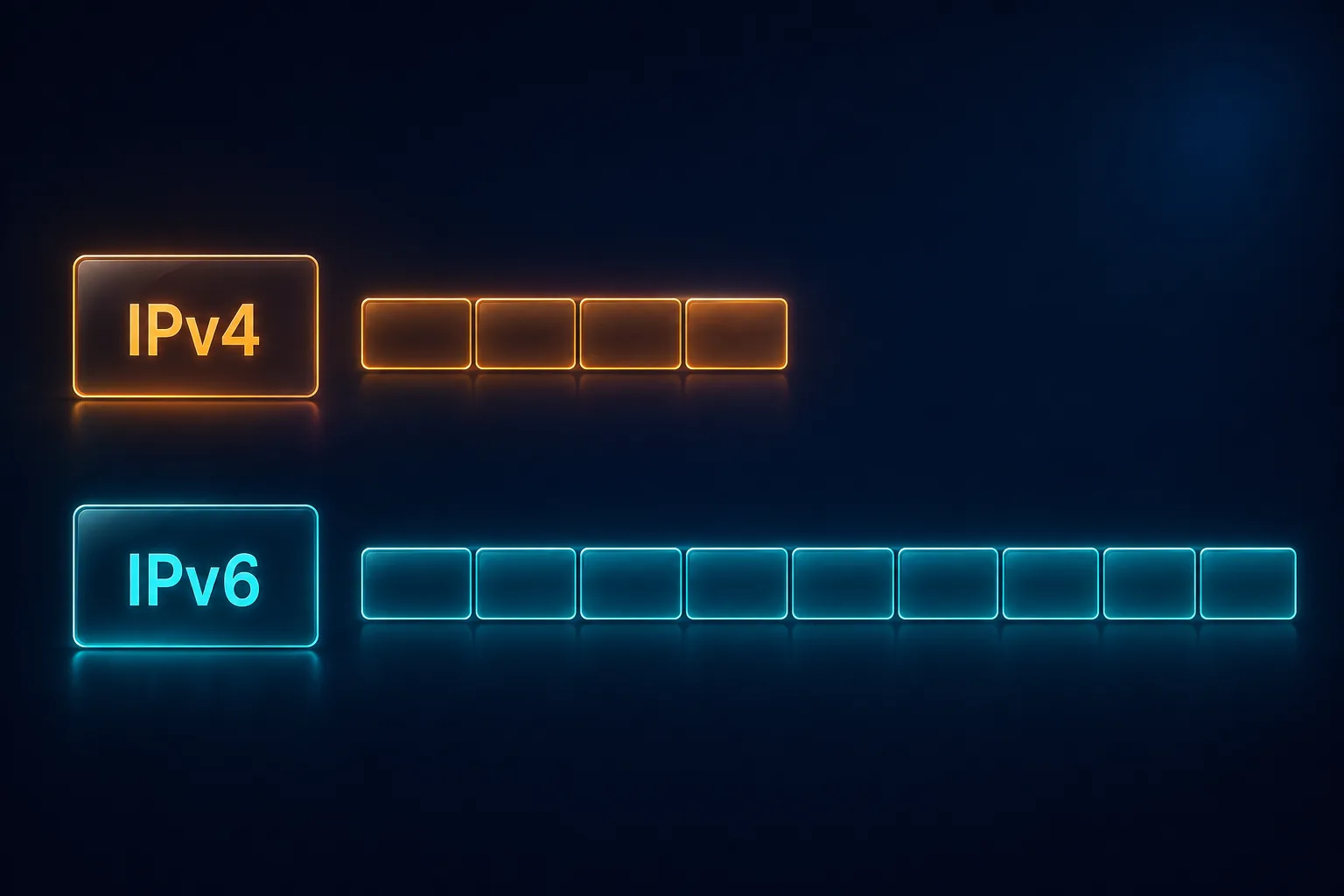
The two protocols are not versions of the same thing in the way software versions usually are. They are separate addressing systems that do not natively talk to each other, which is the root of every practical difference that follows.
1IPv4: 32 Bits and a Hard Ceiling
IPv4 addresses are 32 bits long, written as four decimal numbers separated by dots, such as 192.0.2.146. That structure allows roughly 4.3 billion unique addresses. When the protocol was designed in the early 1980s, that seemed limitless. With billions of phones, servers, and devices online, it is not. The regional registries that hand out address blocks ran out of freely available IPv4 space years ago, which is why unused IPv4 addresses now trade as a genuine commodity.
2IPv6: 128 Bits and Effective Infinity
IPv6 addresses are 128 bits long, written as eight groups of hexadecimal digits separated by colons, such as 2001:0db8:85a3:0000:0000:8a2e:0370:7334. The address space is about 340 undecillion, a number large enough that exhaustion is not a practical concern. IPv6 also simplifies packet headers and removes the need for network address translation in many setups.
3Why They Cannot Talk Directly
This is the crux. An IPv6-only client cannot open a connection to an IPv4-only server, or the reverse, without a translation layer in between. The two systems run in parallel across the internet, a situation called dual-stack, where hosts that support both can reach everything. A server that has never enabled IPv6 is simply unreachable from an IPv6-only proxy. No amount of configuration on your end changes that.
Compatibility: The Factor That Decides Everything
If you take one thing from this article, take this: with proxies, compatibility matters far more than price or raw speed.
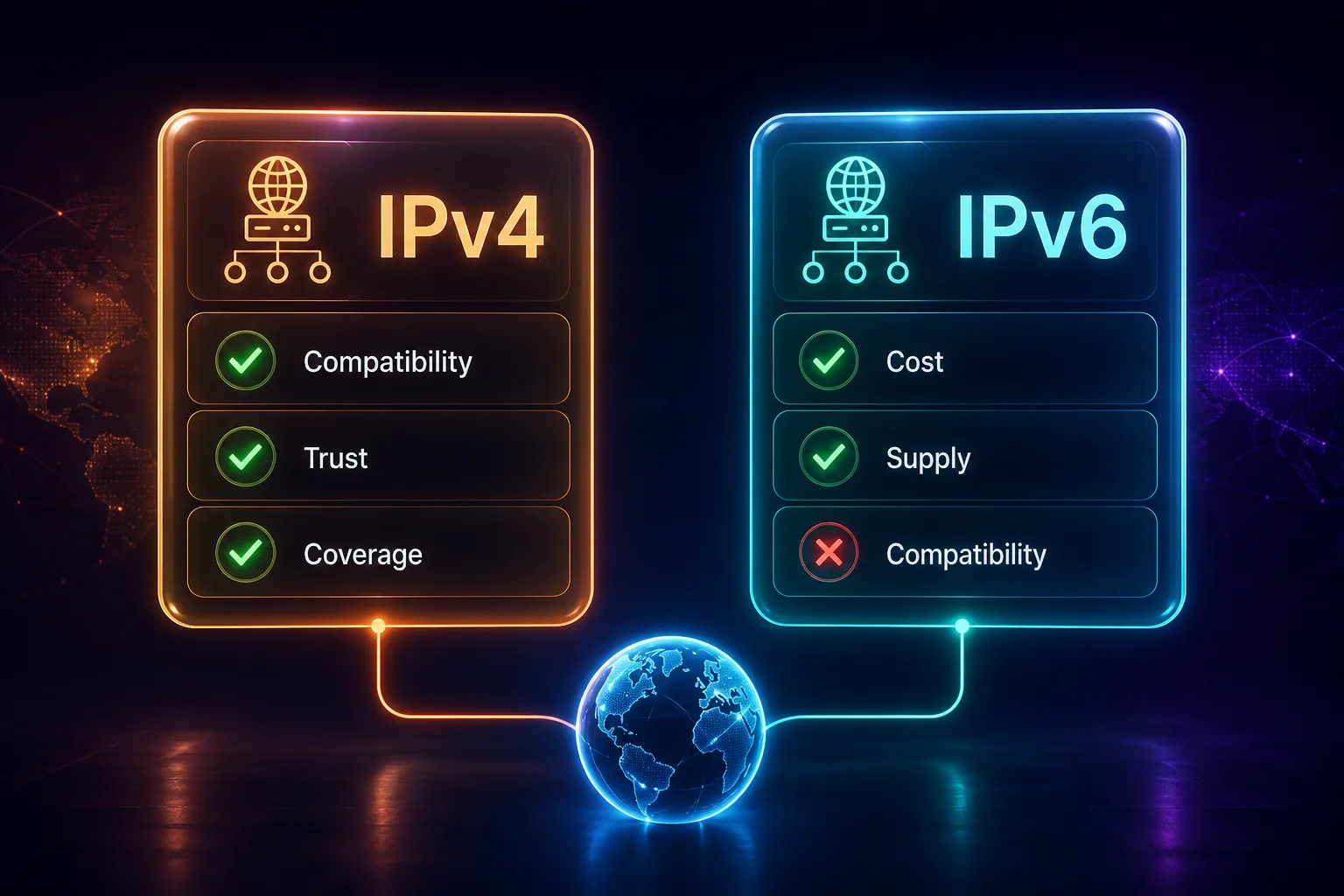
IPv4 works everywhere. Every server, CDN, and API on the public internet accepts IPv4 connections, because it has to. That universality is precisely why IPv4 addresses remain valuable despite being older and scarcer.
IPv6 works only where the destination has enabled it. Adoption has grown steadily and many of the largest platforms are dual-stack, but a very large share of the web, especially smaller sites, older infrastructure, corporate systems, and plenty of e-commerce and travel platforms, remains IPv4-only. Point an IPv6 proxy at one of those and the connection fails before any anti-bot system is even involved. It is not a block; the route does not exist.
There is a second, subtler compatibility problem. Because IPv6 addresses are allocated in enormous contiguous blocks, a site that wants to stop abuse from an IPv6 range does not ban one address, it bans the whole /64 subnet, which can be billions of addresses. On IPv4, banning one address affects one address. This makes IPv6 proxy pools far easier to neutralise in bulk, and it is why they are often already flagged on the very targets people buy them for.
Performance: Closer Than the Marketing Suggests
IPv6 is sometimes sold as inherently faster. The reality is more nuanced.
IPv6 does have genuine architectural advantages. Its simplified, fixed-length header is slightly cheaper for routers to process, and because it removes the need for network address translation, packets can take a marginally more direct path. In controlled tests on well-provisioned dual-stack networks, IPv6 sometimes edges ahead by a small margin.
In practice, though, that difference is dwarfed by everything else. Server location, proxy provider quality, pool congestion, and network routing have far more influence on your actual throughput and latency than protocol version does. A well-run IPv4 proxy near your target will comfortably outperform a distant, overloaded IPv6 one. Treat performance as a tie and decide on the factors that genuinely differ: compatibility, trust, and cost.
Cost: Where IPv6 Genuinely Wins
The price gap is real and it is large. IPv4 proxies are priced by scarcity, so a dedicated IPv4 address typically costs a meaningful amount per month, and providers meter them carefully. IPv6 addresses cost providers almost nothing to allocate, so IPv6 proxies are frequently sold in bulk, sometimes thousands of addresses for the price of a handful of IPv4 ones.
For a workload that genuinely needs an enormous number of distinct IPs and runs against confirmed IPv6-ready targets, that economics is compelling. The mistake is treating the low price as a general-purpose bargain. Cheap addresses that cannot reach your target have a real cost of zero value, not a low cost.
Trust and IP Reputation
Beyond raw reachability, the two types carry different reputations with anti-bot systems.
IPv4 has decades of established reputation infrastructure behind it. Address ranges are well documented, and systems can distinguish a residential ISP allocation from a datacenter block with reasonable precision. That works in your favour when you use quality residential IPv4 addresses, which read as ordinary users. Our guide on how proxy IP reputation works covers the mechanics.
IPv6 tends to be treated with more suspicion. Because addresses are so plentiful and cheap, abuse is cheap too, so many platforms apply blunter, broader rules to IPv6 traffic. Combined with subnet-level banning, this means an IPv6 proxy pool can go from working to entirely dead very quickly. For any task where you need to look like a genuine user, IPv4 residential addresses remain far safer. See how websites detect proxy traffic for the wider detection picture.
When to Use IPv4 Proxies
IPv4 is the right default for the overwhelming majority of proxy work.
1Account Management and Social Platforms
Anything involving logging into accounts needs the trust and universal compatibility of IPv4, ideally residential or mobile addresses. Social platforms are among the strictest about IPv6 traffic.
2General Web Scraping
Because you cannot control which sites appear in a crawl, IPv4 guarantees you can actually reach them. This is why our roundups of the best residential proxies and guidance on why web scraping needs proxies assume IPv4.
3E-commerce, Travel, and Search
Retail, airline, and search targets are frequently IPv4-only or hostile to IPv6, and they are heavily defended. IPv4 is the only sensible choice.
4Anything Where Reliability Matters
If a failed request costs you money or corrupts a dataset, pay for compatibility. IPv4 removes an entire category of failure.
When IPv6 Proxies Actually Make Sense
IPv6 is not useless. It is a specialist tool with a narrow but real set of jobs.
The classic fit is very high-volume traffic against a target you have verified supports IPv6. If you need millions of requests spread across an enormous number of distinct addresses, and the destination is dual-stack, IPv6 delivers scale at a price IPv4 cannot match.
It also suits internal and controlled environments, such as testing your own IPv6-enabled infrastructure, load-testing services you operate, or research on IPv6 adoption itself. Some large platforms with mature dual-stack support are workable IPv6 targets in practice.
The rule is simple: test first, buy second. Confirm your specific target resolves and responds over IPv6 before committing to a pool. If it does not, no amount of cheap addresses will help.
How to Check if a Site Supports IPv6
This takes a minute and saves a lot of wasted spend.
The quickest method is a DNS lookup for the site’s AAAA record, which is the IPv6 equivalent of the A record. If a domain has no AAAA record, it has no IPv6 address and an IPv6-only proxy will never reach it. You can check with a command-line DNS tool or any online DNS lookup service.
Having an AAAA record is necessary but not sufficient. The site may still serve IPv6 poorly, rate-limit it harshly, or block known IPv6 proxy ranges outright. So follow the DNS check with a live test: route a small batch of real requests through the IPv6 proxy and measure the actual success rate before scaling. If you want to see what your own connection looks like, our what is my IP address tool shows the address you present.
Where NAT and CGNAT Fit In
One reason IPv4 has survived its own exhaustion is network address translation, and it has direct consequences for proxies. NAT lets many devices share a single public IPv4 address, which is why your home router presents one address to the internet no matter how many devices you own. Carrier-grade NAT (CGNAT) extends the same idea across an entire ISP, so thousands of subscribers can sit behind one public address.
For proxy users this cuts both ways. It is part of why residential IPv4 addresses read as trustworthy: a single address genuinely does represent many real people, so a site cannot assume traffic from it is automated. But it also means IPv4 addresses are shared, and an address can carry the reputation of everyone behind it. IPv6 removes the need for NAT by giving every device its own address, which is architecturally cleaner but strips away the crowd you were hiding in, making each address easier to attribute and to ban.
Dual-Stack: The Practical Middle Ground
Dual-stack means running both protocols side by side, and it is how most of the modern internet actually operates. For proxy users, the equivalent strategy is to keep an IPv4 pool as your reliable default and add IPv6 capacity only for the specific high-volume jobs where you have confirmed it works.
Many providers support both, so you can route intelligently: send traffic over IPv6 where the target supports it and fall back to IPv4 everywhere else. That gives you IPv6 economics where they apply without sacrificing reach. If you build this, make sure your client handles connection failures cleanly, as covered in our guide to handling proxy timeouts and errors.
Common Mistakes to Avoid
These errors account for most disappointment with IPv6 proxies.
1Buying IPv6 Purely on Price
The low cost per IP is meaningless if the addresses cannot reach your targets. Always validate compatibility before you buy in bulk.
2Assuming IPv6 Is Simply Newer and Better
It is newer, but for proxy work newer does not mean better. IPv4’s universal compatibility is a feature, not legacy baggage.
3Using IPv6 for Account Work
Social platforms and account systems treat IPv6 with heavy suspicion and ban by subnet. This is the fastest way to lose accounts.
4Ignoring Subnet-Level Bans
On IPv6, one abusive user can get an entire /64 range blocked, taking your addresses with it. A huge pool is not the protection it appears to be.
5Skipping the Live Test
An AAAA record proves a route exists, not that your requests will succeed. Always run a real batch before scaling.
Frequently Asked Questions
The Bottom Line
IPv4 and IPv6 proxies are not competing versions of the same product. They are different tools with a decisive trade-off: IPv6 gives you effectively unlimited addresses at very low cost, while IPv4 gives you the ability to actually reach every destination on the internet.
For almost everyone, IPv4 is the correct choice. Account management, general scraping, e-commerce, search, and anything where reliability matters all depend on universal compatibility and established IP reputation. Reserve IPv6 for high-volume workloads against targets you have specifically verified support it, and always test before you buy in bulk.
Ready to choose? Compare providers and address types in our proxy directory, or read up on HTTP, HTTPS, and SOCKS5 proxies and proxy authentication methods to get the rest of your setup right.
Keep Reading
More articles you might enjoy