How Proxy IP Reputation Works (2026)
How proxy IP reputation works: the signals that build or break an IP's trust score, who scores it, how to check your proxies, and how to keep IPs clean.
![How Proxy IP Reputation Works ([year])](/_next/image?url=https%3A%2F%2Fproxyhorizon.com%2Fcdn%2Fblog-images%2Fproxy-ip-reputation-1-msbklvor.webp&w=3840&q=75)
You buy a fresh batch of proxies, plug them in, and half your requests still hit CAPTCHAs or outright blocks. The IPs "work", they connect fine, but the sites treat them like trouble anyway. That gap between a working IP and a trusted one has a name: IP reputation, and it's the invisible score that decides whether you sail through or get stopped at the door.
Automated traffic now rivals human traffic on the web (Imperva), so sites can't just welcome every visitor. Instead, they judge your IP address before you do anything at all, scoring it on history, type, and behavior. A clean IP gets the benefit of the doubt. A flagged one gets a CAPTCHA, a rate limit, or a silent block. Understanding how that score is built is the difference between proxies that quietly work and proxies that quietly fail.
This guide breaks down what proxy IP reputation actually is, the signals that make or break it, who's doing the scoring, how to check your own IPs, and how to keep them clean. If you want the related picture on how detection systems flag automated traffic, our guide on how APIs detect VPN and proxy traffic pairs well with this one.
What Proxy IP Reputation Actually Is
IP reputation is a trust score that networks, websites, and security vendors assign to an IP address based on its history and characteristics. Think of it like a credit score for an IP: it isn't about who you are right now, it's about everything that address has done, or been associated with, in the past. A high score means "probably a real, well-behaved user." A low score means "treat with suspicion."
The critical thing to grasp is that this judgment happens before your request is even processed. The moment your connection arrives, the destination already has an opinion about your IP, pulled from blocklists, fraud databases, and its own logs. That's why a technically perfect setup can still fail: the IP walked in with a bad name. Reputation is the first filter, not the last.
The Signals That Build or Break an IP's Reputation
No single factor decides an IP's fate. Scoring systems blend several signals, and a weakness in one can be outweighed by strength in others, or compounded into a hard block. These are the ones that matter most.
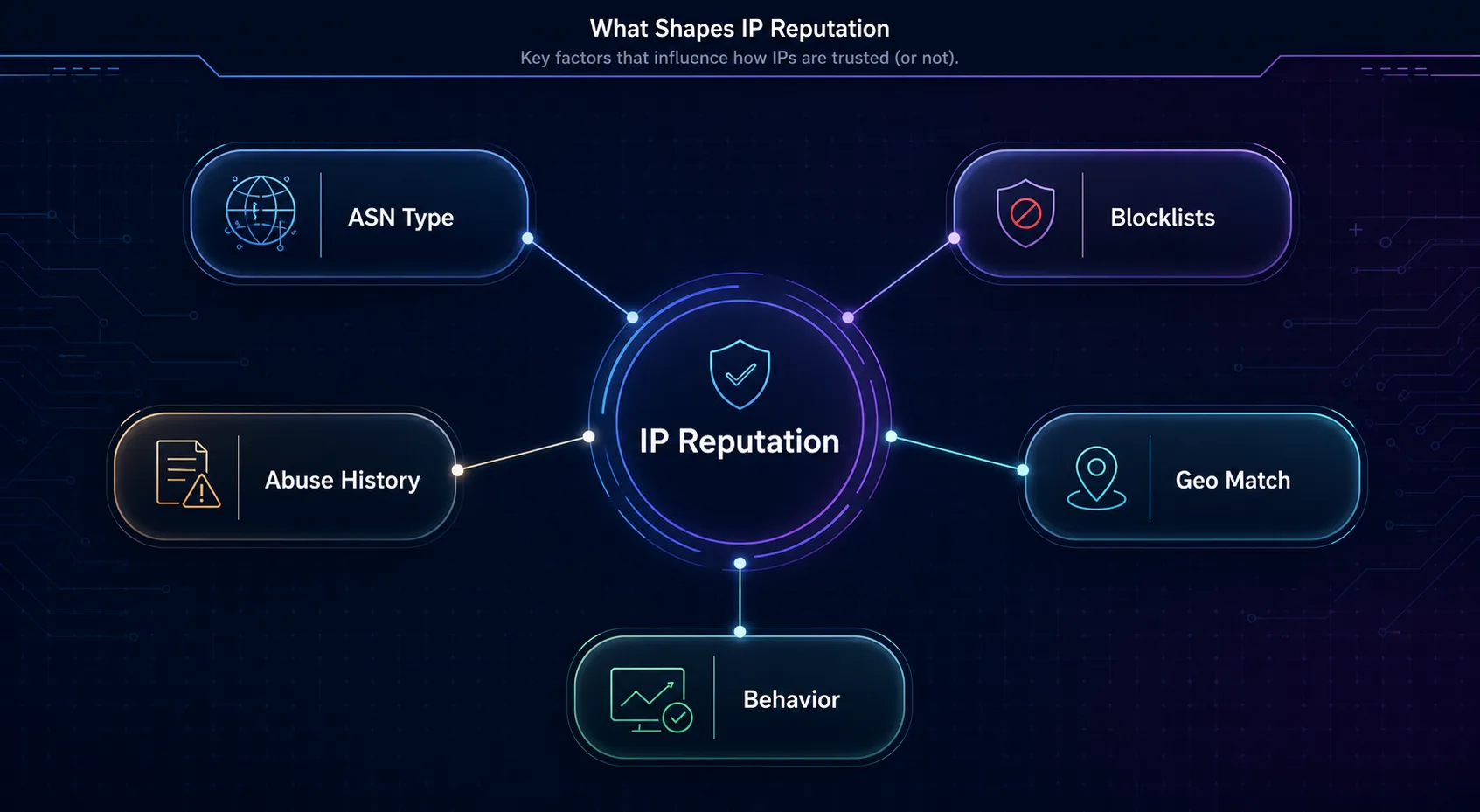
| Signal | What it checks | Why it matters |
|---|---|---|
| ASN and IP type | Whether the IP belongs to a hosting provider, an ISP, or a mobile carrier | Datacenter ranges are easy to classify as non-human and start with lower trust |
| Blocklist presence | Whether the IP appears on spam or abuse blocklists | A listing is a direct, public black mark that many sites check automatically |
| Abuse history | Past spam, fraud, scraping, or attack reports tied to the IP | A record of bad behavior lowers the score even after the behavior stops |
| Geolocation consistency | Whether the IP's location matches the timezone, language, and account it's used with | Mismatches look like evasion and raise suspicion |
| Request behavior | Rate, timing, and patterns of the traffic from that IP | Machine-gun request bursts flag an IP fast, even a clean one |
| Sharing and age | How many users share the IP and how long it's been active | Overused or brand-new IPs both look riskier than a stable, lightly shared one |
The ASN, the number identifying the network an IP belongs to, is the fastest tell of all. If your IP sits in a known hosting ASN, any system can classify it as a datacenter address in a fraction of a second, no history required.
Who Actually Scores Your IP
Reputation isn't one central database; it's a web of overlapping judges, and your IP is scored by several at once. Knowing who they are demystifies why blocks feel inconsistent.
First, blocklists like Spamhaus maintain public lists of IPs tied to spam and abuse, which countless mail servers and websites query automatically. Second, commercial fraud databases such as MaxMind and IPQualityScore sell risk scores that flag proxies, VPNs, and suspicious ranges. Third, anti-bot vendors like Cloudflare and DataDome fold IP reputation into a bigger risk model alongside fingerprint and behavior. Finally, the target site itself keeps its own logs and can flag an IP based on what it did there specifically. An IP can look fine to one and terrible to another, which is exactly why results vary site to site.
Why Datacenter IPs Start With a Trust Deficit
Here's the uncomfortable truth for anyone chasing cheap proxies: datacenter IPs begin the race behind. They live in hosting ASNs owned by companies like the big cloud providers, and those ranges are trivially identifiable as "not a home user." Since real people rarely browse from a server farm, many sites treat datacenter traffic with default suspicion.
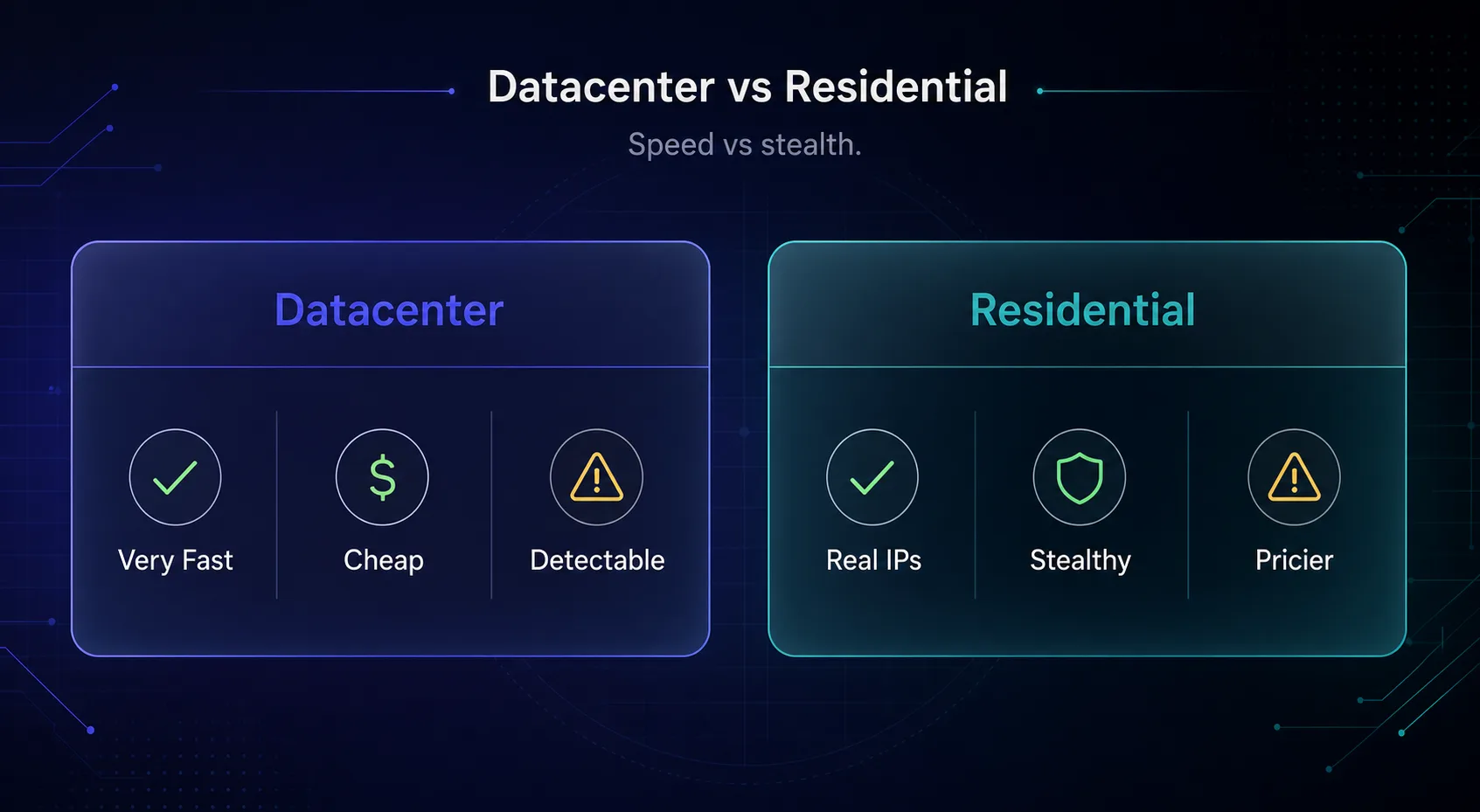
| Factor | Datacenter IPs | Residential / mobile IPs |
|---|---|---|
| ASN owner | Hosting provider | Consumer ISP or mobile carrier |
| Default trust | Low, easily classified | High, looks like a real user |
| Best for | Lenient sites, speed, bulk tasks | Strict sites, account work, stealth |
| Reputation risk | Flagged by type alone | Depends on the pool's cleanliness |
This doesn't make datacenter proxies useless. On lenient targets they're fast and cost-effective, as our roundup of the best datacenter proxies shows. But when reputation is the deciding factor, residential proxies inherit the trust of the real ISPs they come from, which is why they cost more and win on strict sites.
Clean vs Flagged: What the Difference Looks Like
In practice, the reputation gap shows up as a success-rate gap. A clean IP loads the page. A flagged one gets a challenge, a fake "empty" result, or a straight block, often without telling you why.
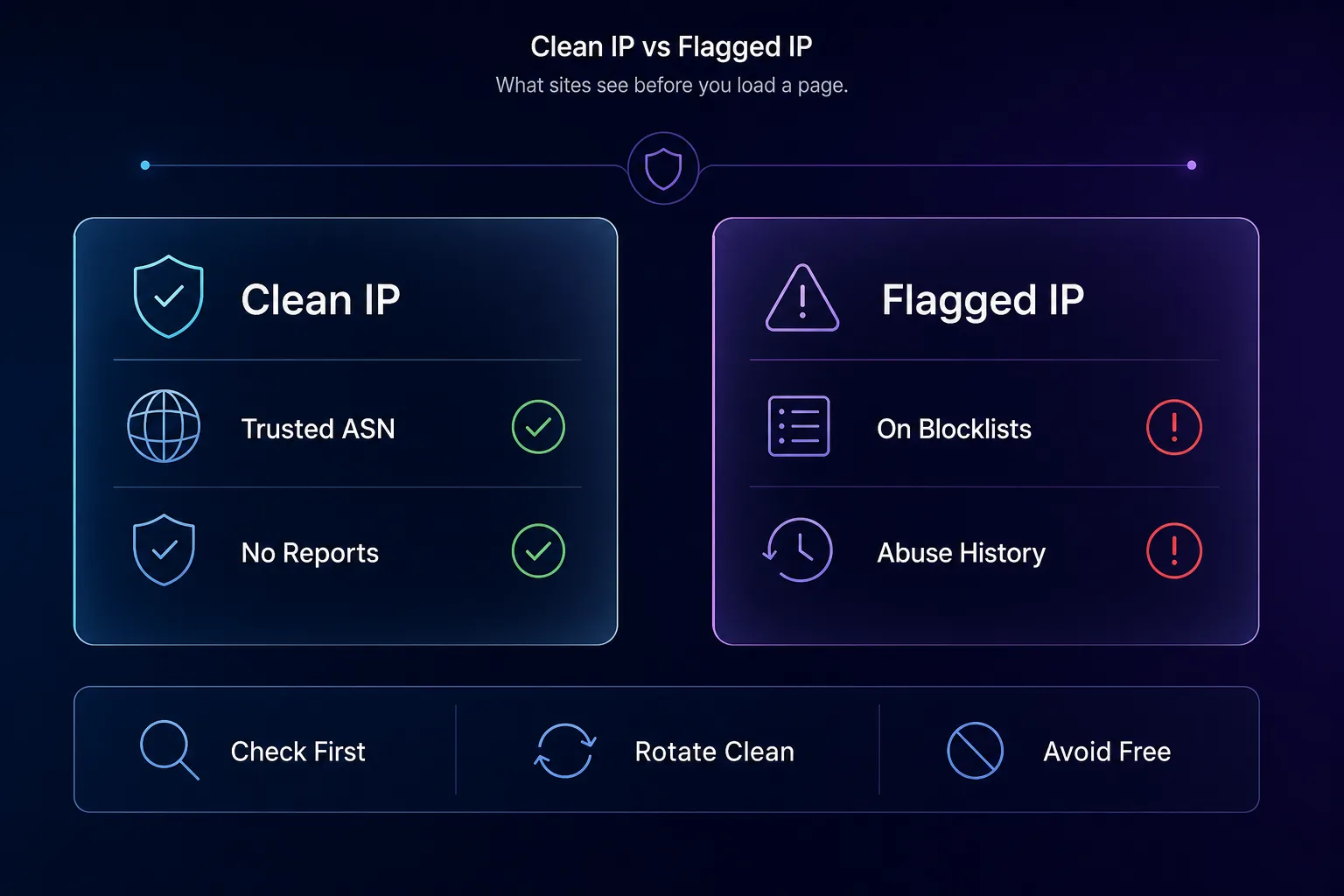
The frustrating part is how invisible it is. A flagged IP doesn't error out; it connects perfectly and then quietly underperforms. You see more CAPTCHAs, lower success rates, and inconsistent data, and you blame your code or your headers when the real problem walked in with the IP. This is also why the cheapest pools cost more in the end: recycled, overused IPs carry baggage that turns into retries and failures.
How to Check Your Proxy IP's Reputation
You don't have to guess. Several tools score an IP's reputation and fraud risk, and it's worth checking a sample from any pool before you commit to it. Fraud-scoring services like IPQualityScore and MaxMind return a risk score and flag whether an IP is a known proxy or VPN. Blocklist lookups tell you if an address is publicly listed. Even a quick look at the IP's ASN reveals whether it's residential or datacenter.
The practical method: pull a handful of IPs from your provider, run them through a reputation checker, and confirm they aren't flagged, aren't on blocklists, and geolocate where they claim to. Then test them against your actual target, because a good score on a generic checker still isn't proof they'll pass your specific site. Our free tool to check your IP address is a fast first step to see what a site sees when you connect, and our guide on whether websites can see your IP explains what's exposed by default.
Where to Get High-Reputation Proxies
The surest way to good reputation is to start with a provider that vets its pool. How we picked: we favored providers known for clean, well-sourced IPs, active pool hygiene, and strong success rates on tough targets. A quick disclosure: some links below are affiliate links, and we may earn a commission if you sign up, which never changes our recommendations.
1NodeMaven

NodeMaven is built around exactly this problem. Its filter-first approach screens IPs for quality before they ever reach you, so you're pulling from a pre-vetted, cleaner slice of the pool rather than luck of the draw. For work where reputation decides success, that screening is the whole point.
The network is smaller than the enterprise giants, so it's less about raw scale and more about IP quality per request. If you keep hitting flags on cheaper pools, NodeMaven's cleaner IPs are a direct fix.
2SOAX

SOAX pairs a large, well-maintained residential and mobile pool with careful IP vetting, so its addresses tend to carry strong reputations. Precise geo-targeting also helps you keep location consistent, which avoids the geolocation-mismatch flag that trips up sloppier setups.
Costs can climb as you scale and some controls sit on higher tiers, but for clean IPs with accurate geo, it's a reliable choice that keeps flag rates low.
3Oxylabs

Oxylabs brings enterprise-grade pool hygiene to the table. Its large residential network is actively maintained, and its unblocking tools are designed to keep success rates high even on the strictest, most reputation-sensitive targets. For high-volume work where consistency matters, that maintenance shows.
It's premium infrastructure at a premium price, so it's more than a small project needs. But when reputation and reliability at scale are the priority, it's a top pick. Compare all three in our proxy provider directory.
How Much IP Reputation Matters, by Use Case
Reputation isn't equally critical for every job. Knowing where it makes or breaks results helps you spend on IP quality only where it actually counts.
For scraping lenient public sites, moderate reputation is fine and datacenter IPs often work, because the target barely checks. For account management on social platforms, reputation is everything: a single flagged IP can lock an account, so clean residential or mobile IPs are non-negotiable. Ad verification needs geo-accurate, trusted residential IPs so you see the same ads a real local user would, not a bot-flagged variant.
Sneaker copping and other limited-release targets are the most reputation-sensitive of all, since those sites aggressively block anything that smells automated, so premium, low-footprint IPs are the price of entry. For market research and price monitoring at scale, the balance tips toward clean rotating residential pools that hold success rates high across thousands of requests. Match the IP quality to how hard the target defends itself, and you stop overpaying on easy jobs and underpaying on the hard ones.
Common Mistakes That Wreck IP Reputation
Even good IPs go bad through misuse. These are the habits that turn a clean pool into a flagged one.
1Using Free or Ultra-Cheap Proxies
Free and bargain pools are shared by countless users doing who-knows-what, so their IPs are often already on blocklists before you touch them. You inherit someone else's abuse history the moment you connect. For anything that depends on reputation, a reputable paid pool pays for itself in success rate.
2Hammering Targets With Aggressive Request Rates
Even a pristine IP gets flagged if you fire requests like a machine gun. Volume and timing are reputation signals too, so realistic pacing and delays protect the IP. Blowing through rate limits is one of the fastest ways to burn a good address.
3Ignoring Geolocation Consistency
Running an account or session through IPs that jump between countries looks like evasion. Keep the IP's location consistent with the timezone, language, and account it's tied to. A German account suddenly logging in from three continents is a textbook red flag.
4Never Rotating, or Rotating Wrong
Pinning every request to one IP overuses it until it's flagged; rotating on every single request can look robotic and break sessions. Match your rotation strategy to the task so no single IP takes all the heat and none of them behave unnaturally.
5Skipping the Reputation Check Entirely
Buying a pool on faith and only discovering the flags mid-project wastes time and money. Spend five minutes sampling IPs through a reputation checker before you scale. It's the cheapest insurance in the whole workflow.
Frequently Asked Questions
The Bottom Line
IP reputation is the quiet gatekeeper of every proxy project. It's decided before your request lands, built from ASN type, blocklists, abuse history, geolocation, and behavior, and judged by a web of blocklists, fraud databases, and anti-bot vendors at once. A working IP and a trusted IP are not the same thing, and the difference shows up as your success rate.
The takeaway is simple: start with clean IPs, then don't ruin them. Choose a provider that vets its pool, check a sample before you scale, pace your requests, and keep your geolocation consistent. NodeMaven leads on filtered, clean IPs, SOAX pairs clean pools with precise geo, and Oxylabs brings enterprise pool hygiene at scale. Sample a few, verify their reputation, and compare the shortlist in our proxy provider directory before you commit.
![IPRoyal vs Thordata ([year]): A Detailed Comparison](/_next/image?url=https%3A%2F%2Fproxyhorizon.com%2Fcdn%2Fblog-images%2Fiproyal-vs-thordata-1-mu5cuh95.webp&w=3840&q=75)
![OpenClaw vs Hermes Agent: Which Is Better? ([year])](/_next/image?url=https%3A%2F%2Fproxyhorizon.com%2Fcdn%2Fblog-images%2Fopenclaw-vs-hermes-agent-1-mu16j93j.webp&w=3840&q=75)
![Grok Bot vs OpenClaw vs Hermes vs n8n ([year])](/_next/image?url=https%3A%2F%2Fproxyhorizon.com%2Fcdn%2Fblog-images%2Fgrok-bot-vs-openclaw-vs-hermes-vs-n8n-1-mtzmbk5w.webp&w=3840&q=75)