Best Apify Actors for Scraping Social Media in 2026
The eight Apify Actors that actually hold up for Instagram, TikTok, X, YouTube, Reddit and more, plus the proxy layer and legal limits that decide whether your social scraping pipeline survives.
Writing your own Instagram scraper is a fun weekend. Maintaining it is a part-time job you didn’t apply for. Social platforms ship layout changes, rotate GraphQL endpoints, tighten rate limits, and add detection signals on their own schedule, and every one of those breaks a hand-rolled parser at 3am on a Sunday.
That maintenance burden is precisely what Apify Actors exist to absorb. An Actor is a packaged, containerized scraper someone else keeps working: you hand it a JSON input, it runs in the cloud, and it drops structured results into a dataset you can pull as JSON, CSV, or Excel. For social media specifically, where the anti-bot pressure is highest and the DOM churns fastest, that division of labor is worth real money.
This guide covers the eight Actors that actually hold up for social data collection, how the pricing model behaves when you scale past a test run, the proxy layer that decides whether any of them succeed, and where the legal line sits. If you want the platform economics in depth first, our Apify pricing breakdown and full Apify review cover that ground.
- Actors are prebuilt, maintained scrapers. You pay for the run, not for the engineering time to keep a parser alive.
- Instagram, TikTok, and X have the strongest maintained Actors. Facebook and LinkedIn are the most fragile and the most legally sensitive.
- Pricing splits into compute-based and pay-per-result Actors. Pay-per-result is far easier to forecast for social work.
- Residential proxies are effectively mandatory on Instagram and TikTok. Datacenter IPs fail fast on both.
- Public data is the safe zone. Logged-in scraping, private profiles, and personal data pull you straight into ToS and GDPR territory.
Why Renting a Scraper Beats Building One
The economics here are unusually clear. A social scraper is not hard to write once. It is brutal to keep running, because you are maintaining code against an adversary who changes the target deliberately and without notice.
Automated traffic now rivals human traffic across the web (Imperva), and social platforms have responded with some of the most aggressive detection on the internet. Behavioural analysis, TLS fingerprinting, device attestation, and account-level trust scoring all stack on top of plain rate limiting. Our breakdown of how social platforms detect multiple accounts covers how deep that goes.
An Actor pushes that fight onto its maintainer. When Instagram changes a response shape, the Actor developer patches it and every user gets the fix, usually within days. You write no code at all if you use the platform UI, or a few lines if you drive it through the API.
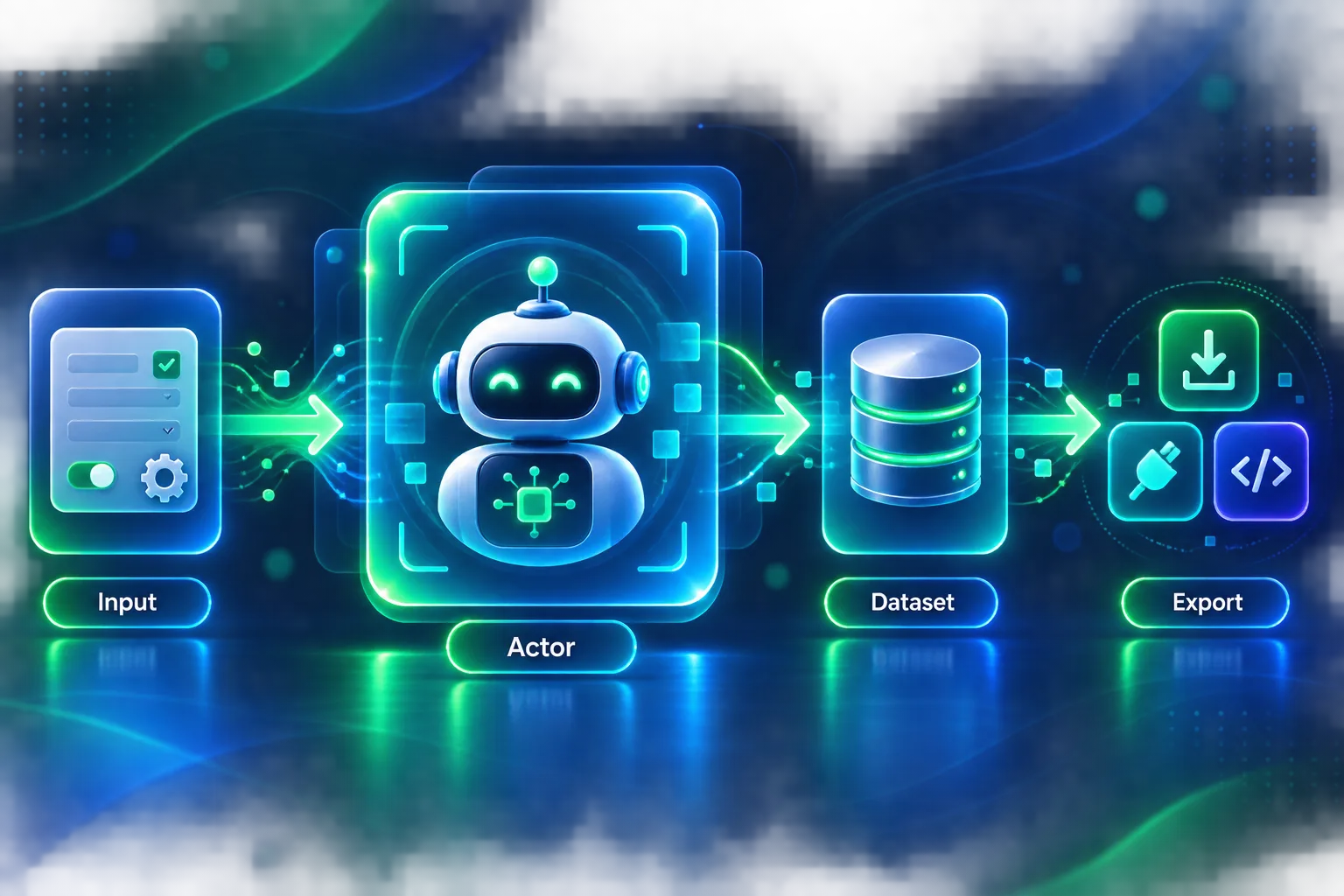
Our take: build your own only when the data shape is genuinely unusual or the volume is high enough that per-result pricing stops making sense. For everything else, renting is cheaper than staffing.
How Actor Pricing Behaves in the Real World
Two models exist on the Store and they behave completely differently at scale.
Compute-based Actors bill by compute unit, which is memory multiplied by runtime. A heavier browser-based Actor left running on a large memory allocation burns credits whether it finds anything or not. Forecasting cost means forecasting runtime, which is hard when the target site is slow or the Actor retries.
Pay-per-result Actors charge a flat rate per item returned. Cost scales with output rather than with time, which makes budgeting trivial: multiply the rate by how many posts or profiles you need. Most of the popular social Actors have moved to this model, and for social work it is almost always the one you want.
| Model | You pay for | Best when | The risk |
|---|---|---|---|
| Compute units | Memory multiplied by runtime | Custom or long-running crawls | Slow targets and retries inflate the bill |
| Pay per result | Each item returned | Predictable social data pulls | Per-item rate can exceed compute cost at huge volume |
| Monthly rental | A flat fee plus usage | Actors you run continuously | You pay the fee in months you barely run it |
Residential proxy traffic is billed separately by the gigabyte on top of either model, and on Instagram or TikTok that line item is not optional. Budget for it from the start rather than discovering it on the first invoice.
The Best Apify Actors for Social Media Scraping in 2026
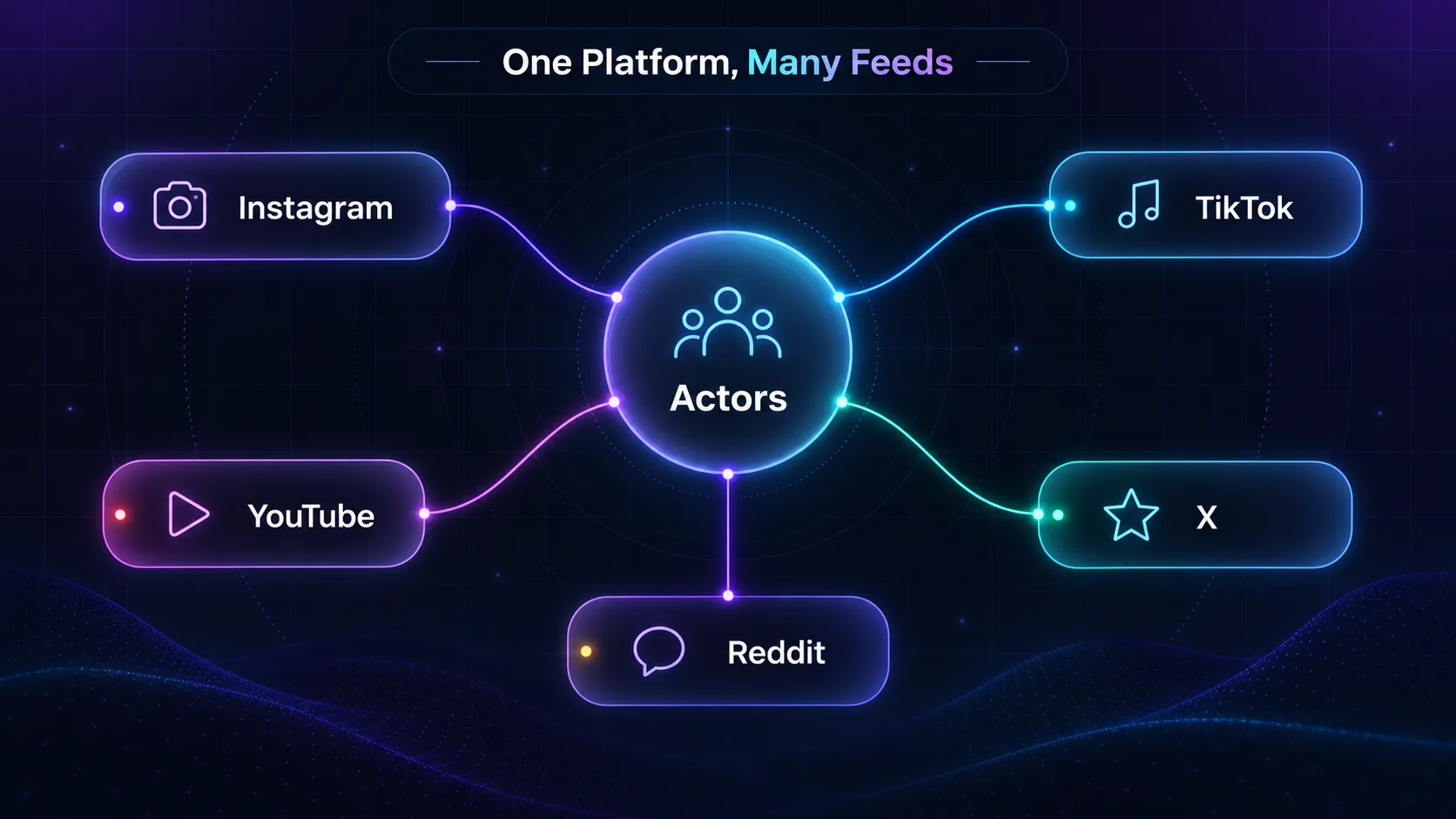
Eight Actors, ordered roughly by how reliable they are in production. One caveat that applies to every entry: the Store evolves, maintainers change, and Actor IDs occasionally move. Search the Store by name and check the maintainer’s recent update history before you wire anything into a pipeline.
1Instagram Scraper
The workhorse of the category and the most complete social Actor on the platform. Maintained by Apify itself under the apify/instagram-scraper path, it handles profiles, posts, reels, comments, hashtags, and location pages from a single input, and returns a consistently shaped dataset regardless of which entry point you used.
Because Apify maintains it directly, patch turnaround after an Instagram change is faster than most community Actors. It is also the Actor where proxy choice matters most: run it on datacenter IPs and you will watch success rates collapse within a few hundred requests. Pair it with residential IPs and it holds up. Our guide to the best Instagram proxies covers what actually survives there.
2TikTok Scraper
The Clockworks TikTok Scraper is the most-used TikTok Actor on the Store, and deservedly so. It pulls videos by profile, hashtag, sound, or search term, and returns engagement metrics, author metadata, music details, and the video URLs in one pass.
TikTok is arguably the hardest mainstream target right now, with heavy signature checks on its internal API and aggressive regional rate limiting. That makes maintenance quality the whole ballgame, and this Actor has a long track record of being patched quickly. Expect to spend on residential bandwidth. Our notes on proxies for TikTok automation explain why mobile and residential IPs behave so differently there.
3Tweet Scraper for X
Since X closed off free API access, scraping became the only affordable route to public post data, and the Apify Store filled that gap fast. The apidojo Tweet Scraper handles search queries, user timelines, replies, and conversation threads, and returns full engagement metrics alongside the post text.
It is priced per result, which makes it genuinely competitive against X’s own API tiers for research and monitoring workloads. The honest caveat: X changes its unofficial endpoints frequently and enforcement has been erratic, so treat throughput as variable and build retry logic into whatever consumes the dataset.
4YouTube Scraper
The most forgiving target on this list, and the Actor reflects that. The Streamers YouTube Scraper collects video metadata, channel details, view and engagement counts, comments, and subtitle transcripts from search terms, channel URLs, or individual video links.
YouTube tolerates well-behaved automated collection better than any other major platform, so success rates stay high even on modest proxy setups. Transcript extraction is the underrated feature: it turns the Actor into a content research pipeline rather than just a metrics collector. For heavier volumes, our guide to residential proxies for YouTube covers the scaling edge cases.
5Reddit Scraper
Reddit’s official API repricing in 2023 pushed a lot of research and monitoring workloads toward scraping, and the trudax Reddit Scraper is the Actor most of them landed on. It pulls posts and nested comment trees from subreddits, user profiles, or search queries, preserving the thread structure that makes Reddit data useful in the first place.
Sentiment tracking, community research, and product feedback mining are the obvious fits. Reddit blocks aggressively by IP once you push volume, so rotation is essential. We covered the provider side in our roundup of the best residential proxies for Reddit.
6Facebook Posts and Pages Scraper
Apify maintains a family of Facebook Actors covering public pages, posts, comments, reviews, and group content. They work, and they are useful for competitive monitoring and local business research, but this is the most fragile corner of the Store.
Meta gates far more behind a login than the other platforms, changes markup constantly, and litigates scraping more readily than anyone else. Restrict yourself to genuinely public page content, keep volumes modest, and do not build a business-critical pipeline on it without a fallback. If you also manage Facebook accounts at scale, our comparison of antidetect browsers for Facebook covers the adjacent problem.
7LinkedIn Jobs and Company Scrapers
Several LinkedIn Actors exist for public job listings and company pages, and they are genuinely useful for recruitment analytics and market mapping. They are also the entry on this list we would approach most carefully.
LinkedIn pursues scrapers more actively than any other platform on this page and has a long litigation history. Public, non-personal data such as job postings and company descriptions sits on far safer ground than anything tied to individual profiles. Keep it public, keep it aggregate, and get a real legal opinion before commercializing the output. Our guide to proxies for LinkedIn automation covers the infrastructure side.
8Threads Scraper
Threads is young enough that the Actor ecosystem is still thin, which is exactly why it is worth a slot. Community Actors collect public posts, profiles, and replies, and the competitive intelligence value is high precisely because far fewer teams are monitoring it than Instagram or X.
Treat it as an early-mover play rather than a production dependency. Maintenance quality varies more than on the established platforms, so check the update history and run a small test before committing a budget to it.
Social Media Actors Compared
| Platform | Typical maintainer | Difficulty | Proxy needed | Best use case |
|---|---|---|---|---|
| Apify (official) | High | Residential | Influencer and hashtag research | |
| TikTok | Clockworks | Very high | Residential or mobile | Trend and sound tracking |
| X | apidojo | High | Residential | Real-time monitoring and research |
| YouTube | Streamers | Low | Datacenter is often enough | Content research and transcripts |
| trudax | Medium | Rotating residential | Sentiment and community mining | |
| Apify (official) | Very high | Residential | Local business and page monitoring | |
| Community | Very high | Residential | Job market and hiring analytics | |
| Threads | Community | Medium | Residential | Early competitive intelligence |
The Proxy Layer Every Social Actor Depends On
Here is what the Store listings undersell. An Actor is parsing logic. Whether that logic ever sees a page depends entirely on the IP the request came from, and on social platforms that is the variable doing most of the work.
Apify Proxy ships with the platform and offers three tiers. Datacenter IPs are included on paid plans and are fine for YouTube and general web targets. Residential IPs are billed per gigabyte and are effectively mandatory on Instagram, TikTok, and Facebook. There is also a Google SERP pool, which is irrelevant here but useful to know exists.
You are not locked into it. Every Actor accepts a custom proxy configuration, so if you already buy residential bandwidth elsewhere at a better rate, plug it in. That is often the single biggest cost lever on a social pipeline, because bandwidth typically outgrows compute long before you expect it to. Our roundup of the best residential proxy providers compares the per-gigabyte pricing directly.
Two habits separate pipelines that work from pipelines that get blocked. Keep sessions sticky for anything that involves paging through a profile, because rotating mid-crawl looks nothing like a human and triggers exactly the pattern detectors these platforms run. And watch pool reputation: an IP that another customer already burned on Instagram will fail for you too, which is why proxy IP reputation matters more than raw pool size.
Rent or Build? The Honest Trade-Off
Using Apify Actors for Social Data
- Someone else absorbs the maintenance when a platform changes its markup
- Pay-per-result pricing makes costs forecastable before you run anything
- Scheduling, retries, storage, and webhooks come built in
- Proxy integration is one config field rather than a project
- You can test a target in minutes instead of a sprint
- Community Actor quality varies and abandoned ones break silently
- Residential bandwidth is billed separately and adds up fast
- Per-result pricing gets expensive at very high volume
- You inherit the maintainer’s roadmap and their response time
Verdict
For anything under a few million records a month, renting an Actor costs less than the engineering time to keep your own scraper alive. Past that, build the hot path yourself and rent the long tail.
What You Can and Cannot Legally Collect
Worth being direct about this, because most Actor listings say nothing at all.
Scraping publicly accessible data is broadly defensible in many jurisdictions and courts have leaned that way, most notably in the long-running hiQ versus LinkedIn litigation. That is not a blanket permission slip. Three lines matter in practice.
Public versus authenticated. Data visible without logging in is a different legal and contractual category from data behind an account. The moment an Actor uses credentials, you have accepted terms of service and the analysis changes completely.
Personal data. Names, photos, bios, and anything else attached to an identifiable person fall under GDPR and similar regimes regardless of whether the page was public. Public does not mean unregulated. Aggregate and anonymize wherever the use case allows.
Terms of service. Every platform here forbids automated collection in its terms. Breaching terms is a contract matter rather than a criminal one in most places, but it is grounds for account termination and, for a business, a real risk to weigh rather than wave away.
Our take: public metrics, hashtags, and aggregate trend data are the comfortable zone. Building a database of individual people is where teams get into trouble, and no Actor listing will warn you about it.
Common Mistakes That Get Social Scrapers Blocked
1Running Everything on Datacenter IPs
The default proxy setting is the cheapest one, and on Instagram or TikTok it fails almost immediately. Teams then blame the Actor, switch to another Actor, and hit the same wall. Check the proxy configuration before you conclude anything is broken.
2Setting Concurrency to the Maximum
Apify lets you raise concurrency freely, and it is tempting because runs finish faster. Social platforms rate limit per IP and per pattern, so high concurrency through a small pool produces exactly the burst signature detection systems look for. Slower and steadier finishes more jobs.
3Ignoring Schema Drift
Actors get patched, and patches sometimes change field names or nesting. A pipeline that silently expects the old shape will keep running and quietly write nulls for weeks. Validate the dataset schema on every run and alert on unexpected changes.
4Scraping the Same Data Repeatedly
The most common cost blowout is re-collecting records you already have because the pipeline has no deduplication. Key your dataset on the platform’s own post or profile ID and skip what you have seen. On a pay-per-result Actor this single change can halve the bill.
Wondering what teams actually build with it? Our guide to the best use cases of Apify covers lead generation, price monitoring, AI pipelines and more.
Frequently Asked Questions
Where to Start
If you are testing the waters, start with the YouTube Scraper. It is the most forgiving target, it works on cheap proxies, and it will teach you the input, dataset, and export flow without a wall of blocks confusing the picture.
If you already know what you need, the Instagram and TikTok Actors are the two that repay the effort most, because they are the platforms where building your own is genuinely painful and the maintained option is genuinely better. Budget for residential bandwidth from day one, key your dataset for deduplication before your first real run, and keep collection to public data.
The one thing worth doing before committing a budget: run a single small job against your actual target and check both the success rate and the proxy bandwidth it consumed. That number, not the Store listing, tells you what this will really cost at scale. Compare it against a direct API alternative using our roundup of web scraping APIs, or browse the provider directory if bandwidth turns out to be your bottleneck.
Keep Reading
More articles you might enjoy