How Are Residential Proxies Sourced? Ethical Proxy Pools Explained (2026)
Every residential proxy IP is someone’s home connection. Learn how proxy pools are built, what makes proxies ethically sourced, and six questions to ask a provider before you buy.
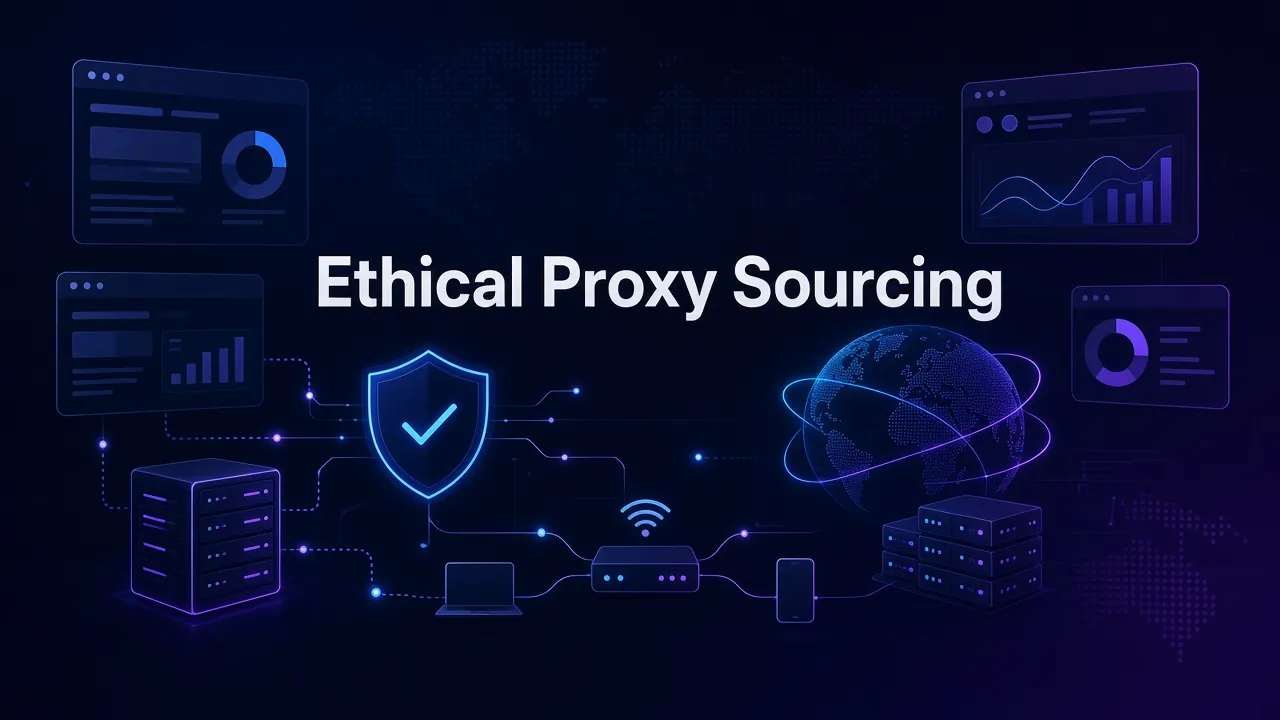
Every residential proxy IP belongs to someone’s home connection.
A phone, a laptop or a smart TV is passing your requests to the website, usually through a backconnect gateway that hides which device you got. The only question is whether its owner agreed to that, understood it and got something back.
That question isn’t academic anymore. In 2026, Google took down a proxy network built largely on apps that never told users their devices were exit nodes. Companies that bought from resellers of that pool may never have known.
This guide explains how residential proxy pools are actually built, what “ethically sourced proxies” should mean in practice, and the six questions that separate a documented answer from a marketing badge.
- Residential proxy IPs come from real consumer devices running software that routes traffic through them.
- Dedicated bandwidth-sharing apps and clear opt-in SDKs are the two consent-based sourcing routes.
- Hidden SDKs and malware built some of the largest pools, including IPIDEA and 911 S5.
- Ethical sourcing means informed consent, a real reward and an easy opt-out, backed by proof.
- Ask providers for named sources, the consent screen and an independent audit before you buy.
Where Do Residential Proxy IPs Come From?
Residential proxy IPs come from real consumer devices running software that lets a provider route traffic through them. That software reaches devices in four main ways, and only two of them involve real consent.
Google’s threat intelligence team described the supply side plainly in its January 2026 IPIDEA report. Devices are either pre-loaded with proxy software, joined through apps with embedded proxy code, or enrolled by people who knowingly install software to “monetize” spare bandwidth.
If you need a refresher on the product itself, start with what a residential proxy is. Here we’re looking one layer down, at the device behind the IP.
| Sourcing route | How the device joins | Consent |
|---|---|---|
| Dedicated bandwidth-sharing app | The owner installs an app whose whole purpose is sharing bandwidth for pay | Explicit |
| Opt-in SDK inside another app | A game or utility offers “no ads” or free features in exchange for sharing | Explicit, if the screen is clear and opt-out works |
| Buried or undisclosed SDK | The same code, with consent hidden in a licence or missing | None in any real sense |
| Malware or trojanized software | Fake VPNs, pirated software or pre-infected devices | None, and criminal |
There’s also a fifth source that sits outside the device question. Some “residential” IPs are leased from internet providers and hosted in data centers. Oxylabs’ handbook calls this route less ethically sensitive because no end user is involved. Those are what we call ISP proxies.
How Opt-in SDKs and Bandwidth-Sharing Apps Work
The two consent-based routes look similar from the outside. The difference is who chose the software and who gets paid.
1Dedicated Bandwidth-Sharing Apps
With a dedicated app, the person installing it is the person sharing. The app exists to share bandwidth, so there’s no feature to hide it behind.
Oxylabs says a majority of its pool comes from apps of this kind, naming Honeygain and Bixberry in its Residential Proxy Pool Handbook. It describes participants as fully informed, explicitly consenting and paid directly.
Bright Data runs its own app, EarnApp. Its EULA says the app uses your IP address and spare resources to download web pages in the background, and that you can’t use it if your internet provider’s agreement prohibits sharing your connection. That last clause is a detail most users skip.
2Opt-in SDKs Inside Other Apps
An SDK is a code library an app developer adds to their app. Proxy SDKs pay the developer, and the developer passes value to the user, usually by removing ads.
Bright Data’s peer network docs describe exactly this trade. Users can skip video ads by opting in, and Bright Data pays the app vendor a monthly fee per opted-in user. It says it only uses the device when idle and charging, and prefers Wi-Fi over cellular data.
Infatica’s trust center lists what its approved consent screen must explain: that the SDK is present, that bandwidth may be shared, what the user gets, that it’s voluntary, and how to opt out.
Our take: the SDK model can be ethical. It’s also the route where things go wrong most often, because the proxy company doesn’t control the app, the screen or the developer’s honesty.
What Unethical Sourcing Looks Like
Unethical sourcing usually isn’t a shady proxy brand admitting it uses malware. It’s a supply chain where nobody asks hard questions.
1Hidden SDKs in Ordinary Apps
Google’s IPIDEA report found over 600 Android apps with code connecting to the network’s control servers. They were largely ordinary utilities, games and content apps whose monetization SDKs quietly turned them into exit nodes.
Google’s response was blunt. Play Protect now warns users, removes apps with known IPIDEA SDKs and blocks future installs. Google said the action shrank the network’s device pool “by millions”.
2Malware and Fake VPNs
The worst case is plain malware. The FBI’s 2024 alert on 911 S5 describes a residential proxy service built on more than 19 million compromised IPs in over 190 countries.
Its supply came from free VPN apps such as MaskVPN and DewVPN, bundled with pirated games and software. They installed a proxy backdoor silently. Criminals then used those home IPs for fraud, bomb threats and identity theft.
3Resold Pools You Can’t Trace
Here’s the catch for buyers. Google noted significant overlap between residential proxy networks, likely because of reseller and partnership agreements. A brand you’ve never heard of may be selling someone else’s pool.
So “we don’t run malware” isn’t enough. The useful question is whether the provider knows where every upstream IP came from.
What Makes a Proxy “Ethically Sourced”?
A proxy is ethically sourced when the device owner knowingly agreed, understood what sharing means, can stop easily, and ideally gets something real in return. Everything else is a matter of degree.
Oxylabs published one of the clearest frameworks for this. Its tiers grade sourcing on four values: financial reward, clear information, user awareness and user consent.
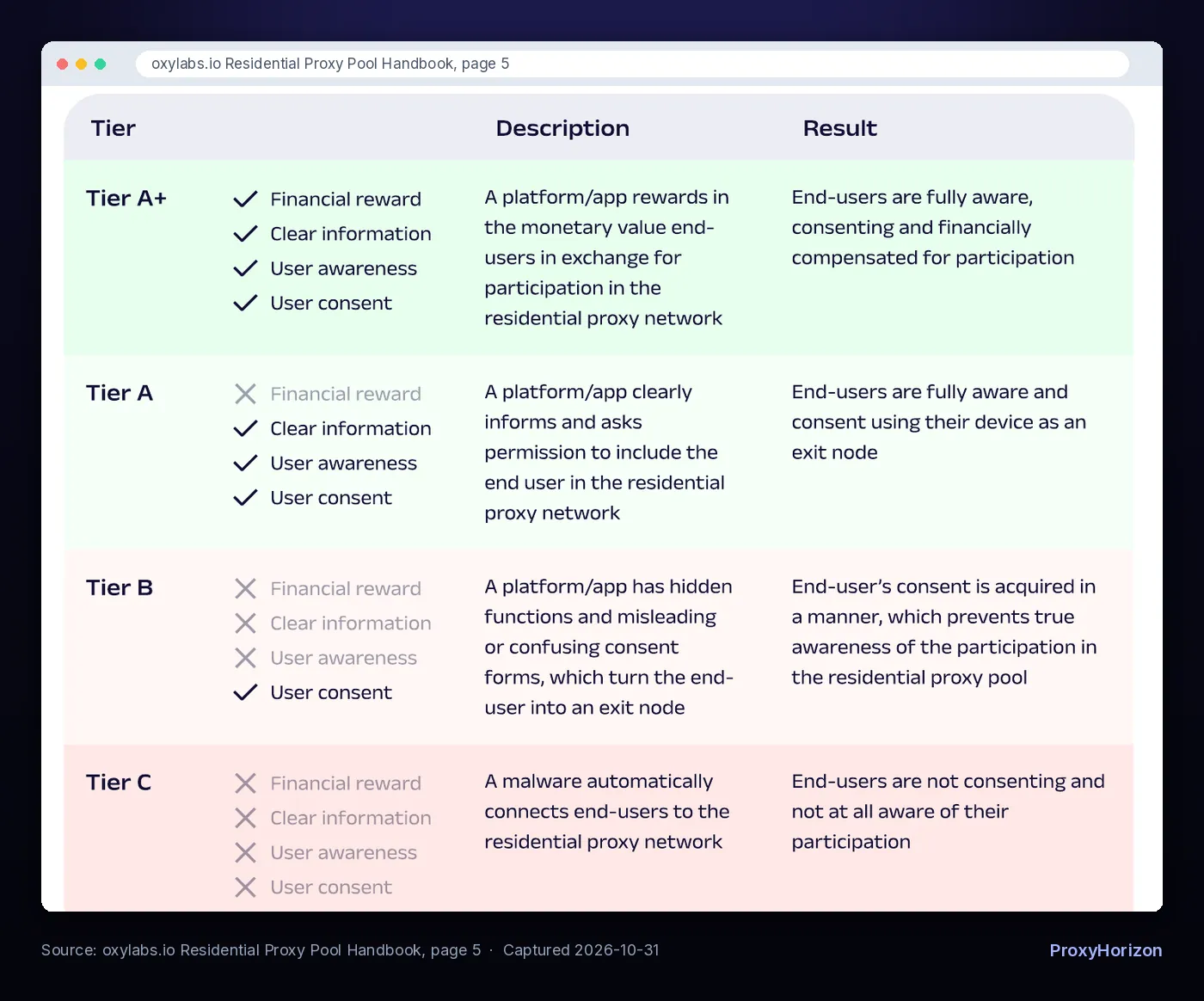
In plain English, Tier A+ users know, agree and get paid. Tier A users know and agree without cash. Tier B users technically clicked something but were misled. Tier C users never knew at all.
Notice where the line falls. Tier B has a “consent” tick, but Oxylabs still treats it as a failure because the user wasn’t truly aware. A checkbox alone doesn’t make a pool ethical.
Industry groups say much the same. The Ethical Web Data Collection Initiative (EWDCI) asks members to source proxies through informed consent and to run Know Your Customer checks on buyers of residential IPs.
Why Sourcing Matters to You as a Buyer
It’s tempting to see this as the provider’s problem. It isn’t, for three practical reasons.
1Your Traffic Shares the IP With Criminals
In a single week of January 2026, Google saw over 550 threat groups using IPIDEA exit nodes, including groups from China, North Korea, Iran and Russia. Your price-monitoring job could be leaving from the same IP as a password-spray attack.
That drags down IP reputation fast. Sites that see abuse from an address start blocking it, and your success rate pays for traffic you didn’t send.
2Pools Can Vanish Overnight
When Google moved against IPIDEA, it took down control domains and had Play Protect remove infected apps. Google expects knock-on effects for affiliated resellers too. A pool built on hijacked devices can lose millions of IPs in a week.
3Compliance and Reputation
If you collect data for a business, someone will eventually ask how. “We routed it through hijacked devices” is not an answer a legal team wants to hear.
Sourcing is part of the same risk picture as web scraping legality and terms of service. Both are easier to defend with documents than with assumptions.
Six Questions to Ask a Provider Before You Buy
Most sales teams will say “ethically sourced”. These questions test whether they can show it.
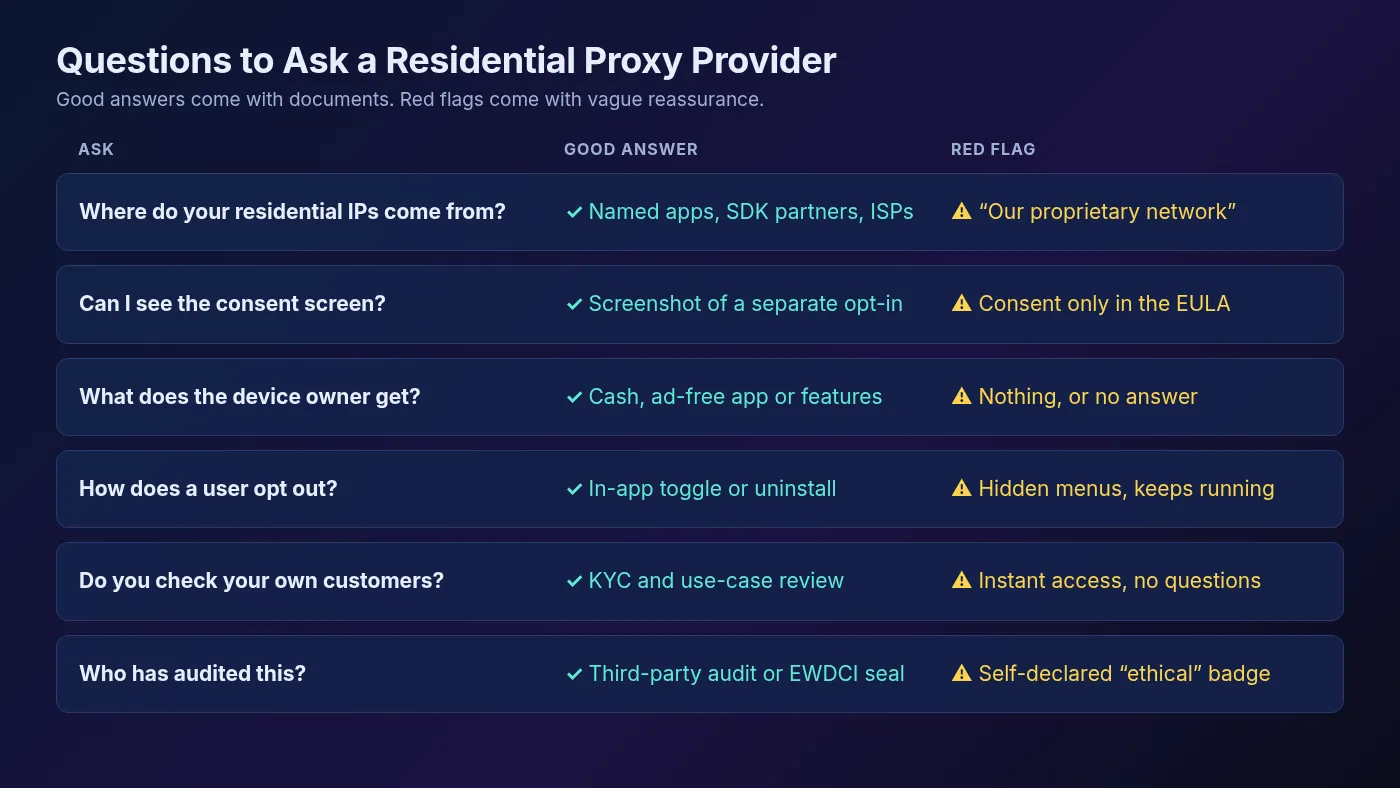
- Where exactly do your residential IPs come from? Look for named apps, SDK partners and ISP agreements, not “our proprietary network”.
- Can I see the consent screen? A real opt-in sits on its own screen before sharing starts. Consent that lives only in a EULA fails the test.
- What does the device owner get? Cash, an ad-free app or unlocked features. “Nothing” or silence is a red flag.
- How does a user opt out? Bright Data’s sourcing page promises a two-click opt-out from a settings menu. Ask for the equivalent.
- Do you vet your own customers? KYC and use-case review protect the device owners. Instant access with no questions means anyone shares the pool with you.
- Who has checked this independently? Self-declared badges are cheap. Ask for audit reports or a third-party accreditation.
Real-world tip: ask these in writing before a large purchase. A provider that answers with screenshots and policy links is easier to defend later than one that answers with adjectives.
How to Verify Claims Yourself
You can’t audit a provider’s whole supply chain. You can check whether its claims hold up in public.
- Read the trust or sourcing page. Bright Data, Oxylabs and Infatica each publish theirs. Vague pages with no partner criteria tell you something too.
- Look for an accreditation you can verify. EWDCI’s trust seal requires membership, a formal review against its principles and a compliance audit run with the i2Coalition. Its public list of accredited providers includes Oxylabs, Decodo and Rayobyte among others (checked October 2026).
- Use transparency tools where they exist. Oxylabs’ IP Transparency tool lets anyone check whether their IP was used in its pool over the last 30 days.
- Search the brand with “botnet”, “malware” and “SDK”. Security research from Google, the FBI and antivirus firms names networks and apps directly.
Accreditation isn’t a guarantee. It does mean someone outside the company looked, which is more than a homepage badge offers.
Common Sourcing Myths
A few beliefs keep buyers comfortable when they shouldn’t.
1“Residential Means Hijacked”
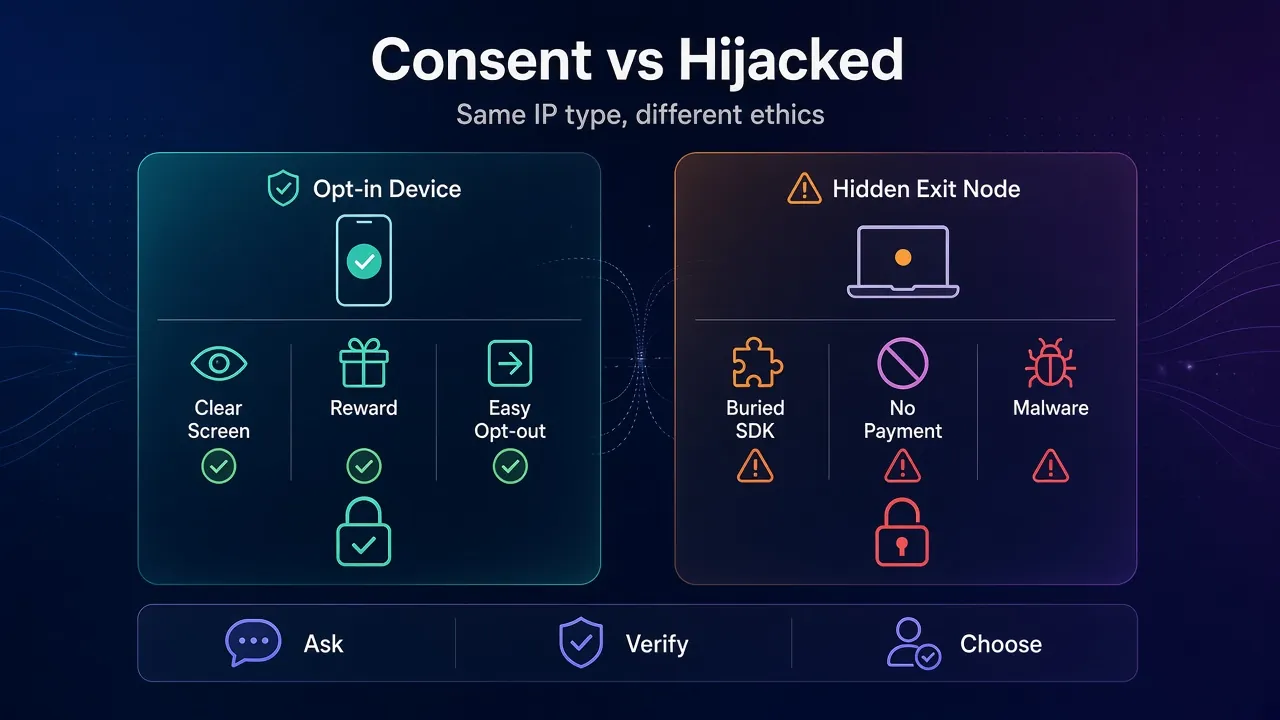
Not true. Dedicated bandwidth-sharing apps and clear opt-in SDKs are legitimate models where owners choose to participate. The IP type says nothing about consent on its own.
2“A Big Provider Must Be Clean”
Size doesn’t prove sourcing. 911 S5 was one of the largest residential proxy services in the world, and it was built on malware. Scale is what bad sourcing makes easy.
3“Consent in the Terms Is Enough”
Oxylabs’ own framework rejects this. Tier B includes misleading or confusing consent, even when a user technically agreed. Awareness is the point, not the click.
When You Might Not Need Residential IPs at All
The most ethical residential IP is sometimes the one you don’t use. Plenty of targets work fine with datacenter or ISP proxies, which involve no consumer device.
If a site doesn’t block datacenter ranges, start there. Our residential vs datacenter guide shows how to tell. Save residential traffic for targets that really need it, and you’ll spend less too.
When you do need residential IPs, our best residential proxy providers list is the place to compare options, and our proxy provider directory covers the wider market. Use the six questions above on any shortlist.
Frequently Asked Questions
Buy the Pool You’d Be Happy to Explain
Ethical sourcing comes down to one test: could the person whose device carries your traffic explain how they joined? If the provider can show the app, the screen, the reward and the opt-out, the answer is probably yes.
Our take: treat “ethically sourced” as a claim to verify, not a feature to tick. Hijacked pools are cheaper to build, so somebody pays the difference, usually the device owner and eventually you.
Before your next purchase, send the six questions to your top two providers. Pick the one that answers with documents. Then test it on a small plan against your real target before you scale.
Keep Reading
More articles you might enjoy