Best Ad Verification Tools in 2026
The nine ad verification platforms worth shortlisting this year, split by buy side and sell side, plus the measurement infrastructure question that decides whether any of their data is trustworthy.

Most advertisers find their fraud problem the same way. A campaign posts great numbers, everyone is pleased, and then someone opens the placement report and finds a chunk of the impressions landed on sites nobody has heard of. The dashboard wasn’t lying. It was measuring the wrong thing.
Closing that gap is the entire job of ad verification tools. They sit between your buying platform and the open web and answer four unglamorous questions: was the ad actually seen, was it next to something that won’t embarrass the brand, was there a human on the other side, and did it run where you paid for it to run. The ANA’s programmatic media supply chain transparency study found roughly 15% of programmatic impressions landing on made-for-advertising sites, which is a polite way of saying a meaningful slice of open-web budget buys nothing at all.
Below are the nine platforms worth shortlisting this year, sorted by who they are genuinely built for rather than who spends the most on trade press. We also cover the part most roundups skip entirely: the measurement infrastructure underneath every one of these vendors, and why it decides whether their data is worth anything.
- Verification splits into four jobs: viewability, brand suitability, invalid traffic, and geo or creative compliance. Most vendors are strong at two of them.
- Buy-side brands want DoubleVerify or IAS. Publishers and SSPs want GeoEdge or Confiant. Performance marketers want TrafficGuard, CHEQ, or Anura.
- MRC accreditation is the only meaningful third-party check on a vendor’s own numbers. Ask which specific metrics are accredited, not whether the company is.
- Every verification platform depends on geo-distributed IPs to see ads the way a real local user does. That layer is invisible in sales decks and it decides data quality.
- Blocking too aggressively costs more in lost reach than the fraud it prevents. Measure first, block second.
Why Verification Stopped Being an Optional Line Item
Ten years ago, verification was something big brands bolted on after a scandal. It is now closer to plumbing. Three shifts did that.
The first is scale of automation. Automated traffic now rivals human traffic across the web (Imperva), and a bot that can pass for a person on a login page can just as easily load an ad, render it, and scroll past it. If you are curious how that arms race actually works at the request level, our breakdown of how anti-bot systems detect automated browsers covers the same detection logic verification vendors use.
The second is supply chain sprawl. A single impression can pass through a DSP, two or three SSPs, a reseller, and a header bidding wrapper before it renders. Each hop is an opportunity for misrepresentation, and no single party in that chain has an incentive to flag it.
The third is that the walled gardens got harder to audit, not easier. CTV in particular is a measurement frontier where device-level signals are thin and server-side ad insertion hides most of what a browser tag would have caught.
Our take: if you spend meaningfully on the open programmatic web and you have no verification layer, you are not buying media. You are donating it.
The Four Things Verification Actually Measures
Vendors blur these together in their marketing, which makes shortlisting harder than it should be. Separate them and the market gets clear fast.
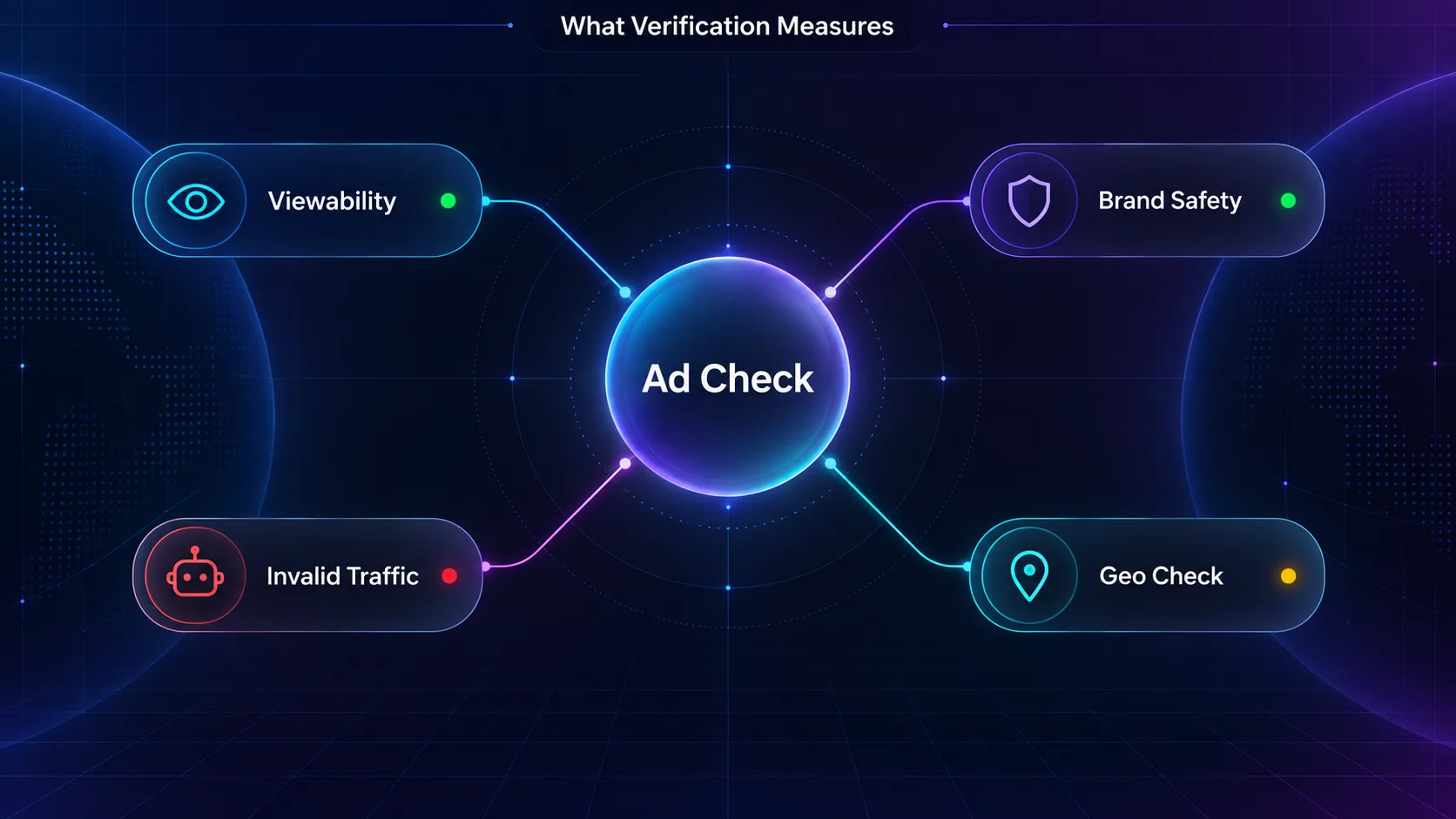
| Pillar | The question it answers | Who cares most |
|---|---|---|
| Viewability & attention | Did the ad render in view, for long enough, with a real chance of being noticed? | Brand advertisers, agencies |
| Brand safety & suitability | What content sat around the ad, and does it match the brand’s risk tolerance? | Large brands, regulated categories |
| Invalid traffic (IVT) | Was the impression or click generated by a human, a bot, or a spoofed device? | Everyone, especially performance marketers |
| Geo & creative compliance | Did the right creative serve in the right market, at the right time, without malicious code? | Publishers, SSPs, global brands |
Sophisticated invalid traffic is where the money hides. General IVT is easy: known data center ranges, declared crawlers, obvious spiders. SIVT is the hard tier, covering hijacked devices, falsified device IDs, injected ads, and bot farms running real browsers on residential connections. Almost every vendor claims SIVT detection. Very few can show you their false-positive rate.
The Best Ad Verification Tools in 2026
Nine platforms, grouped loosely from enterprise measurement down to self-serve fraud blocking. Read the first line of each entry for the fit, because that matters far more than the feature list.
1DoubleVerify
The default enterprise choice for brands that need one vendor across display, video, social, and CTV. DoubleVerify covers all four pillars, holds MRC accreditation across a broad set of metrics, and its Authentic Ad framework rolls viewability, brand safety, fraud, and geo into a single pass or fail signal that plugs into most major DSPs pre-bid.
Its 2024 acquisition of Scibids pushed it beyond measurement into bid optimization, which is either the natural next step or a conflict of interest depending on who you ask. Pricing is a CPM on measured impressions with an enterprise floor, so it is not a fit for small budgets. If you run global campaigns with a compliance obligation attached, it is the safe answer.
2Integral Ad Science
DoubleVerify’s closest competitor, and the better pick if attention metrics and contextual targeting matter more to you than raw compliance reporting. IAS built Quality Attention on top of viewability rather than treating them as separate products, and Context Control lets you target or avoid page-level context with more granularity than a keyword blocklist.
The Publica acquisition gave IAS a genuine CTV ad server position, which shows in how it handles connected TV supply. Buyers often describe its reporting interface as friendlier than DoubleVerify’s. Same enterprise pricing model, same CPM structure, same caveat about minimums.
3HUMAN Security
The specialist to call when your problem is specifically bots rather than brand adjacency. Formerly White Ops, HUMAN’s Satori threat intelligence team has publicly unwound several of the largest ad fraud operations on record, including Methbot and 3ve, and that pedigree shows in detection depth.
MediaGuard applies pre-bid decisioning so fraudulent impressions never reach your bid, and because the company also sells bot mitigation for login and checkout flows, its signal pool spans far more than advertising. If you already fight credential stuffing and scraping, consolidating both problems with one vendor is a real argument.
4Pixalate
The strongest option for mobile app and CTV environments, and the only one on this list that treats privacy compliance as a first-class product. Pixalate holds MRC accreditation for invalid traffic detection in the channels most vendors treat as an afterthought, and its publicly published seller trust indexes are a genuinely useful free resource when you are auditing new supply.
Its COPPA and child-directed app risk reporting has become a differentiator as regulators pay closer attention to app store data practices. Best for ad tech companies, app monetization teams, and anyone whose spend is majority in-app or connected TV.
5GeoEdge
Publisher-side, and unapologetically so. GeoEdge exists to stop bad creatives reaching your readers: malvertising, forced redirects, auto-playing audio, cloaked landing pages, and the offers that generate support tickets. It scans creatives in real time from many geographies and blocks the offending ad rather than just reporting it after the fact.
The reason geography matters here is that malicious advertisers cloak. A creative that looks clean from a New York data center IP can serve a redirect chain to a mobile user in Jakarta. GeoEdge’s value is largely in the breadth of vantage points it checks from, which is exactly the infrastructure problem we get into further down.
6Confiant
The other serious name in creative security, and often the pick for SSPs and exchanges rather than individual publishers. Confiant sits deeper in the supply chain, scoring demand partners on the security and quality of what they deliver, and it publishes threat research that names the specific attacker groups behind malvertising campaigns.
Where GeoEdge is usually deployed to protect one publisher’s users, Confiant is often deployed to hold an entire demand ecosystem accountable. Choose based on where you sit: if you sell inventory to buyers, Confiant’s partner scorecards give you something to negotiate with.
7TrafficGuard
The most practical option for performance marketers who don’t buy programmatic display at all. TrafficGuard focuses on paid search, paid social, and mobile app install fraud, sitting on your Google Ads and app campaign traffic to filter invalid clicks and fraudulent installs before they poison your attribution data.
Pricing scales with volume and starts far lower than the enterprise measurement vendors, which makes it accessible to mid-market advertisers and agencies. The honest limitation: it is not a brand safety or viewability product, so it solves one pillar well rather than four adequately.
8CHEQ
Broader than click fraud, narrower than full verification. CHEQ frames itself around go-to-market security, meaning it filters invalid traffic at the ad click, protects on-site conversion events and form fills, and keeps fake sessions out of your analytics so your funnel metrics stay honest.
That last part is the underrated bit. Bot traffic doesn’t just waste ad spend, it corrupts the conversion rates you optimize against, which means you make worse decisions for months afterward. If your marketing team can’t trust its own analytics, CHEQ solves a bigger problem than the media waste alone.
9Anura
A focused, US-based fraud detection service with an unusually specific pitch: definitive answers rather than risk scores. Anura returns a clear verdict on whether a visitor is real, and the company builds its reputation on keeping false positives low, which matters enormously when you are using that verdict to block traffic automatically.
It is popular with affiliate networks, lead generation businesses, and agencies who need to prove traffic quality to a client or a partner. Not a brand safety tool, and not a measurement suite. A sharp knife for one job.
Ad Verification Platforms Compared
| Platform | Best for | Primary strength | Side of the market |
|---|---|---|---|
| DoubleVerify | Global brands and agencies | Full-stack measurement, broad accreditation | Buy side |
| Integral Ad Science | Attention and context buyers | Attention metrics, contextual targeting, CTV | Buy side |
| HUMAN Security | Bot-heavy environments | Pre-bid fraud detection, threat research | Both |
| Pixalate | CTV and mobile app spend | In-app and CTV IVT, privacy compliance | Both |
| GeoEdge | Publishers protecting users | Malvertising and creative blocking | Sell side |
| Confiant | SSPs and exchanges | Demand partner scoring, creative security | Sell side |
| TrafficGuard | PPC and app install budgets | Click and install fraud filtering | Buy side |
| CHEQ | Performance and demand gen teams | Click, conversion, and analytics protection | Buy side |
| Anura | Affiliate and lead gen operators | Low false-positive fraud verdicts | Buy side |
Check before you buy: ask every vendor which specific metrics carry MRC accreditation and in which channels. Accreditation is granted per metric per environment, not to a company as a whole, and the difference between accredited desktop display viewability and unaccredited CTV fraud detection is the difference between a number you can defend and a number you cannot.
The Measurement Layer Nobody Talks About
Here is the part sales decks leave out. A verification platform’s entire value depends on seeing the ad the way a real user in the target market sees it. That is not a software problem. It is a network problem.
Ad servers make delivery decisions based on the IP that requests the creative. Geo-targeting, frequency capping, currency, language, cloaking logic, and fraud filters all key off it. Which means if you check a campaign from a data center in Virginia, you learn what advertisers show to data centers in Virginia. Nothing more. Cloaked malvertising and geo-mismatched creative both survive that check trivially, because the attacker is filtering out exactly that kind of visitor.
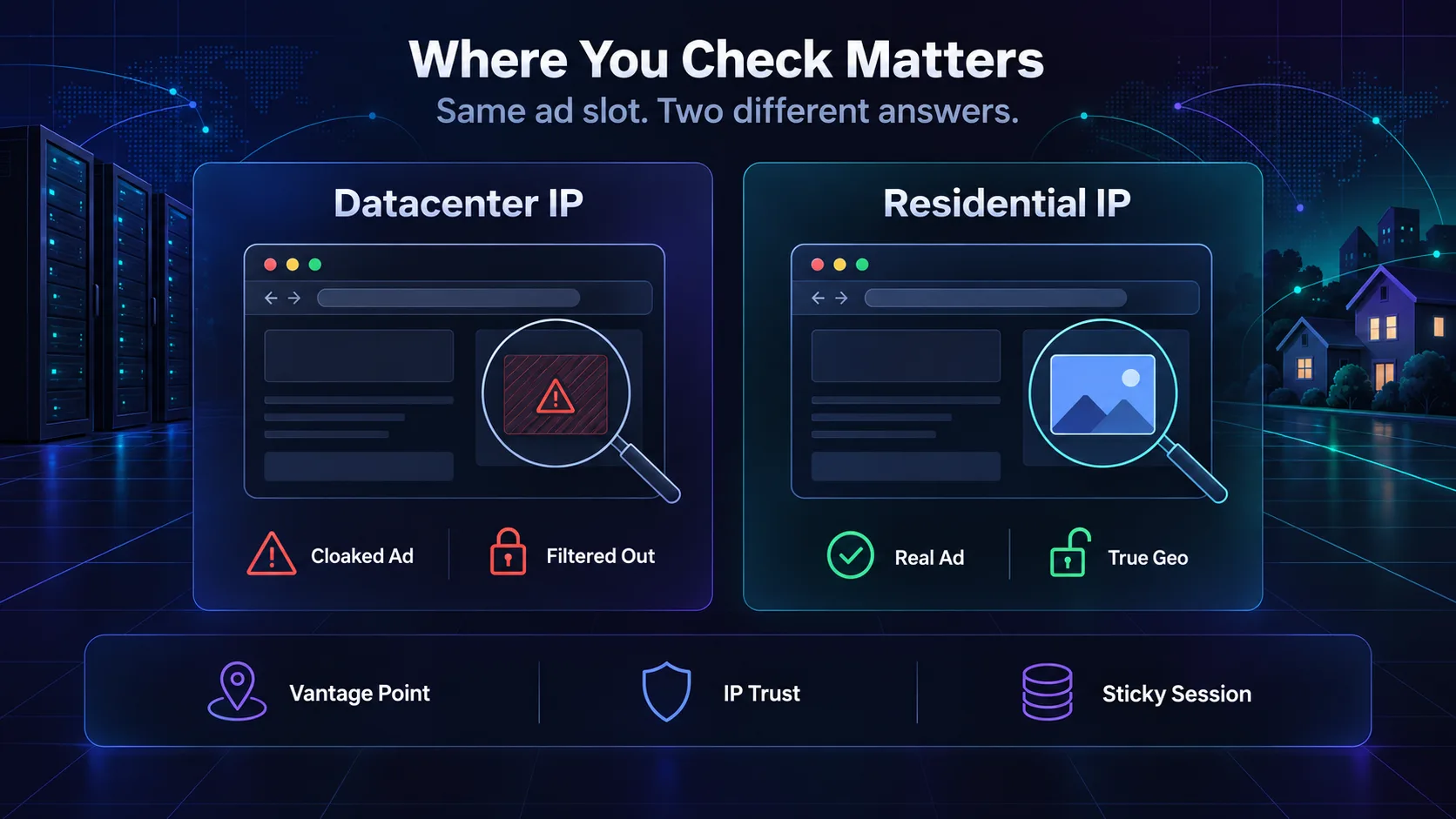
Real verification therefore runs through residential IP addresses and, for mobile-heavy inventory, carrier-grade mobile IPs, distributed across every market being audited. The vendors on this list all operate or license that infrastructure. Teams building any part of this in house need to buy it, and our guide to the best proxies for ad verification walks through which providers hold up under that load.
Two details decide whether the setup works. Session stickiness comes first: a creative check that rotates IP mid-session breaks the ad server’s frequency logic and returns results a real user would never see. Second is IP reputation. An address already flagged as suspicious gets served a different, cleaner ad than a residential IP with a clean history, so the pool’s quality directly skews your findings. Our explainer on how proxy IP reputation works covers why that happens.
Common mistake: evaluating vendors purely on their dashboard while never asking how many countries and what IP types they measure from. That single question separates the platforms that can audit a Brazilian mobile campaign from the ones that can only guess at it.
Is Ad Verification Worth the Line Item?
It costs real money, usually as a CPM layered on top of media, and it introduces friction. Worth stating the trade-offs plainly rather than pretending the answer is obvious.
Running a Verification Layer
- Removes waste that no amount of creative optimization can recover
- Gives you leverage in make-good negotiations with publishers and networks
- Keeps bot sessions out of analytics so conversion data stays trustworthy
- Protects the brand from adjacency incidents that cost far more than the fees
- Creates an audit trail that satisfies procurement and compliance teams
- Enterprise vendors price on CPM and rarely fit small budgets
- Aggressive pre-bid blocking shrinks reach and can raise effective CPMs
- Vendors grade their own homework unless the metric is MRC accredited
- Measurement gaps persist in CTV and in-app environments
Verdict
Above roughly six figures of annual open-web spend, verification pays for itself in recovered waste alone. Below that, a focused click-fraud tool beats a full measurement suite.
How to Choose the Right Verification Vendor
1Start With Which Side of the Market You Sit On
Buy-side and sell-side verification are different products that share a category name. A brand wants to know what it bought. A publisher wants to know what it is about to render to a reader. Deploying a buy-side measurement suite to solve a malvertising problem is a category error, and it happens constantly because the sales conversations sound similar.
2Match the Vendor to Your Actual Channel Mix
If 70% of your spend is connected TV and mobile in-app, a vendor whose accreditation is strongest in desktop display is measuring the smaller part of your business well and the larger part badly. Pull your channel split before the first demo and make every vendor speak to that mix specifically.
3Interrogate Pre-Bid Versus Post-Bid
Post-bid measurement tells you what happened. Pre-bid avoidance stops it happening. Pre-bid is obviously better and obviously more expensive, and it reduces available inventory, which can push your CPMs up. Most mature setups run both: pre-bid on the high-risk supply, post-bid measurement across everything for the audit trail.
4Ask About False Positives, Not Just Detection Rates
Any vendor can catch more fraud by flagging more traffic. The number that matters is how much legitimate traffic they block along the way, and almost nobody volunteers it. Ask for the methodology, ask how disputes are resolved, and run a measurement-only period before you let anything block automatically.
Common Mistakes That Make Verification Useless
1Blocking on Day One
The most expensive verification mistake is switching on aggressive pre-bid blocking before you understand your baseline. Teams do it, watch reach collapse, watch CPMs climb to buy the remaining inventory, and end up worse off than the fraud was costing them. Measure for a full buying cycle first. Then tune.
2Treating Brand Safety and Brand Suitability as the Same Thing
Safety is the floor: no ads next to violence, adult content, or extremism. Suitability is contextual judgment, and it is specific to the brand. A running shoe company might happily advertise against a marathon injury story. An insurer would not. Blanket keyword blocklists demonetize legitimate news at scale while catching almost nothing genuinely unsafe, which is why blocklist bloat is now its own industry problem.
3Ignoring Made-for-Advertising Inventory
MFA sites are technically legitimate. Real pages, real content of a sort, real human visitors sometimes. They are also engineered entirely to arbitrage cheap traffic into ad impressions, and standard fraud detection does not flag them because nothing about them is strictly fraudulent. Ask specifically whether a vendor identifies MFA supply as its own category.
4Never Auditing the Auditor
Verification vendors are measuring their own performance and selling you the report. MRC accreditation exists precisely because that arrangement needs an external check. Where a metric is not accredited, treat the number as a directional signal, not a fact, and cross-check against a second source when the stakes are high.
5Forgetting That Vendors Disappear
Oracle wound down its advertising business and took Moat, once a category-defining measurement product, with it. Buyers who had built reporting, contracts, and internal benchmarks entirely around Moat had to rebuild all of it. Keep your measurement definitions and historical data portable enough to survive a vendor exit, because this market consolidates.
Frequently Asked Questions
Where We Would Actually Put the Budget
If you buy programmatic at scale and answer to a procurement team, the honest shortlist is two names long: DoubleVerify or IAS, chosen on channel mix and whether attention metrics matter to how you report. Everything else in the enterprise tier is a supplement to those, not a replacement.
Publishers should ignore that entire conversation. Your problem is what renders on your page, and GeoEdge or Confiant solves it depending on whether you are protecting readers or policing demand partners.
And if you are a performance team spending five or six figures a month on search, social, and affiliate traffic, skip the measurement suites entirely. TrafficGuard, CHEQ, or Anura will recover more waste per dollar than a full verification stack you will never use half of.
One last thing worth doing before any of it: run a small manual audit of your own campaigns from real residential IPs in your two biggest markets and see what actually renders. It costs almost nothing, and it is the fastest way to find out whether your verification problem is a vendor problem or an infrastructure problem. Our roundup of the best residential proxy providers is the place to start, and the full provider directory lets you filter by geographic coverage if you need specific markets.
Keep Reading
More articles you might enjoy