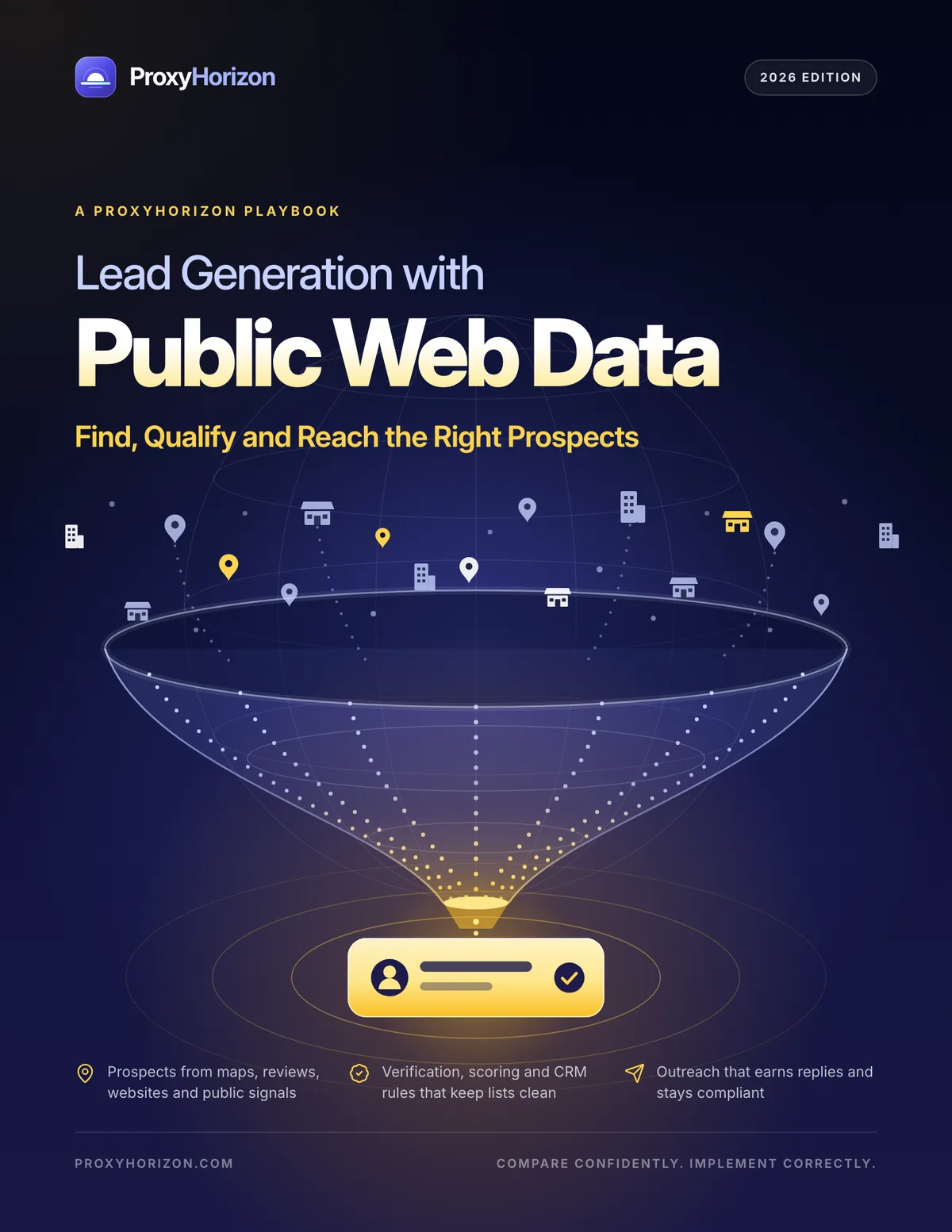
Lead Generation with Public Web Data
The free playbook for finding, qualifying and reaching the right B2B prospects with public web data.
- Ten chapters, from your first list to your first meeting
- Scoring models, signal libraries and worked examples you can copy
- Compliance and deliverability rules checked in November 2026
PDF · 59 pages · 5.3 MB · No sign-up needed
- Pages
- 59
- Chapters
- 10
- Diagrams
- 21
- Tables
- 22
- Code examples
- 3
About the eBook
Everything you need to build a lead engine from public data
Most outbound fails before anyone writes a word: the list was too broad, too stale or built on guesses. Lead Generation with Public Web Data shows you how to build better lists from what businesses publish every day, their Maps listings, websites, job posts, reviews and news, and how to turn that data into a lead engine you can run every week.
It walks through all nine stages, from defining your ICP to learning from replies, with free ProxyHorizon tools, no-code workflows and only two short, optional code snippets. Every chapter ends with key takeaways, and the appendix has a 30-day launch plan, printable checklists and a plain-English guide to GDPR, CAN-SPAM, CASL and UK PECR.
Stop buying lists of everyone. Build a list of the right businesses, at the right moment, for a reason you can name.
By the end, you'll be able to
- Turn your best customers into an ICP you can filter real data against
- Pull prospects from Google Maps, reviews, company websites and other public sources
- Spot the trigger signals that say a business is ready to talk, before they go stale
- Verify contacts and set up SPF, DKIM and DMARC so your emails reach the inbox
- Score leads on fit and intent, route them by tier and keep your CRM clean
- Write outreach that earns replies and follows the rules in each market
Look inside
Real pages from the playbook
Diagrams of the whole engine, tables you can work from, code for developers and checklists you can print. Select any page to see it full size.
What's inside
10 chapters, from your first list to your first meeting
Read chapters 1 and 2 first, then jump to the chapters for your role. Every chapter ends with key takeaways.
- 01p. 5
The Public-Data Lead Engine
Why public data beats bought lists, the nine-stage engine and the four numbers that matter.
- 02p. 9
Define Your ICP and Buying Signals
Firmographics, technographics, timing signals, red flags and a fill-in ICP worksheet.
- 03p. 13
Where Leads Live: A Map of Public Sources
Twelve public sources compared on what you get, difficulty and whether you need proxies.
- 04p. 18
Local Business Leads From Maps and Reviews
Grid searches, deduplication and opportunity scoring from reviews, websites and Maps ranks.
- 05p. 23
B2B Leads From Company Websites
Which pages to read, what to extract, an optional Python snippet and polite crawling rules.
- 06p. 28
Trigger Signals: Timing Beats Volume
Where signals show up, a weighted signal library with shelf lives and a monitoring rhythm.
- 07p. 32
Enrichment, Verification and Deliverability
Finding the right person, the verification ladder, bounce rules and what Gmail, Yahoo and Outlook require.
- 08p. 38
Scoring, Routing and CRM Hygiene
A fit and intent scoring model, A, B and C tiers, routing rules and data decay.
- 09p. 43
Outreach That Earns Replies
Relevant personalization, an annotated cold email, a multichannel cadence, AI drafting and the rules by market.
- 10p. 50
Infrastructure: Proxies, Automation and Cost per Lead
Proxies by source, nine providers, no-code workflows and a worked cost-per-lead example.
- Ap. 55
Appendix
A 30-day launch plan, source and compliance checklists, a glossary and free tools.
Who it's for
Written for people who sell to businesses
Founders doing their own sales
A short list of the right companies, a reason to write to each one, and a process that fits between product sprints.
Agencies running outbound for clients
A repeatable engine you can price, run for several clients at once and defend when someone asks where the data came from.
SDRs, sales ops and growth marketers
Fresher data, better timing from trigger signals, clean routing rules and a CRM the whole team trusts.
Agencies selling to local businesses
Opportunity scoring from reviews, website gaps and Maps rankings, so you pitch the businesses that visibly need you.
FAQ
Questions, answered
Is the book really free?
Yes. There's no sign-up and no email gate: download the PDF and start reading. You're welcome to share it with your team or clients, unchanged and with credit.
Who is it for?
Founders who do their own selling, agencies that run outbound for clients, SDRs, sales ops and growth marketers, and agencies that sell web design, SEO or marketing to local businesses. It assumes no technical background.
Do I need to know how to code?
No. Most of the engine runs on free ProxyHorizon tools, spreadsheets and no-code automation with n8n, Make or Zapier. Two short Python snippets are included for developers, and both are optional.
Is lead generation from public web data legal?
The book sticks to public business information for B2B outreach and explains GDPR, CAN-SPAM, CASL and UK PECR in plain English, with checklists. It's general information rather than legal advice, so check the rules where your recipients are before large campaigns.
What format is it in?
A 59-page PDF of about 5.3 MB, with clickable links and a bookmark for every chapter and section. It's designed for reading on screen and prints cleanly on US Letter or A4.
How current is it?
This is the 2026 Edition. Provider figures come from the ProxyHorizon directory, and the Gmail, Yahoo and Outlook sender requirements were checked in November 2026. Prices and rules change, so the book points you to the live sources.
More free eBooks
All eBooks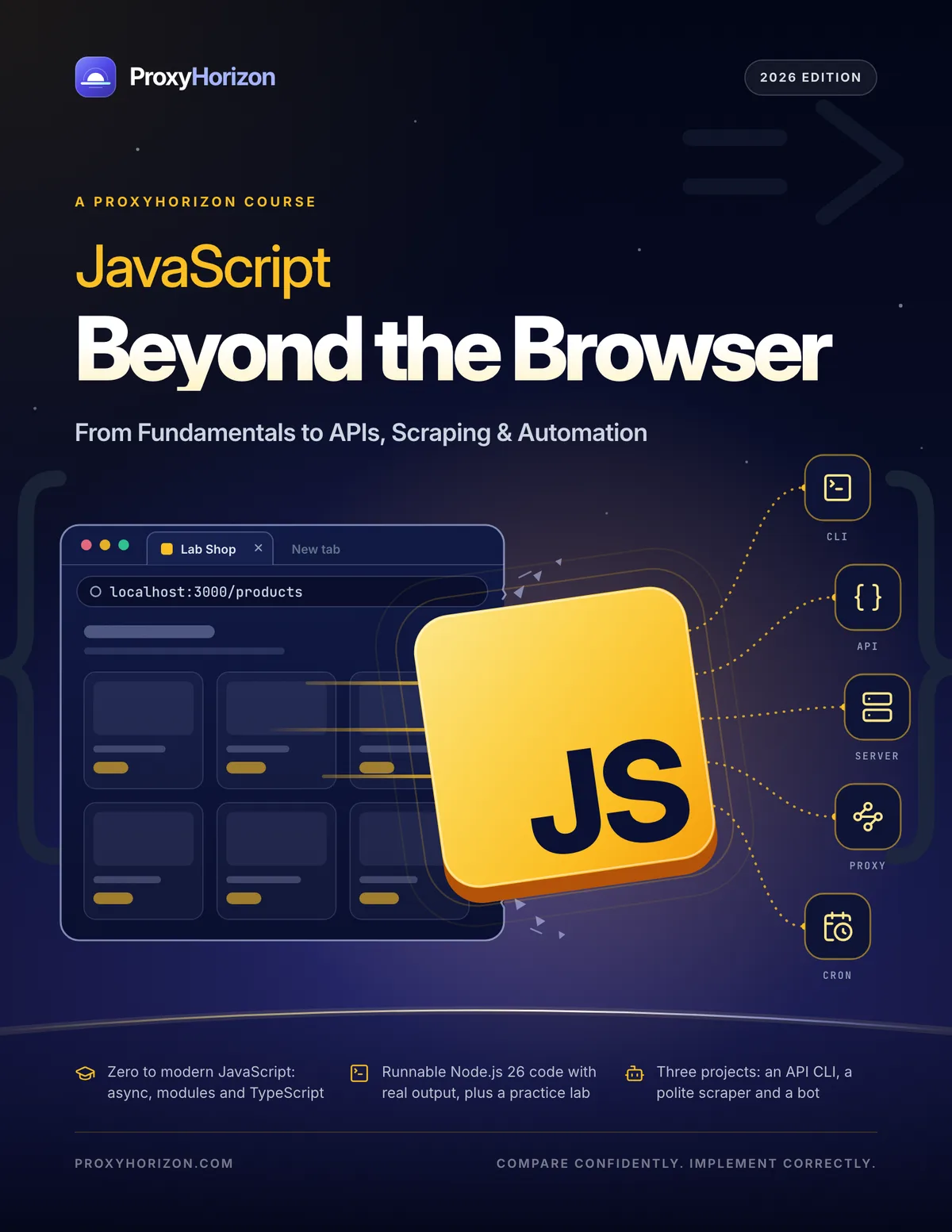
123 pages · Free PDF
JavaScript Beyond the Browser
The free course that takes you from your first line of JavaScript to APIs, scrapers and automation bots.
Read more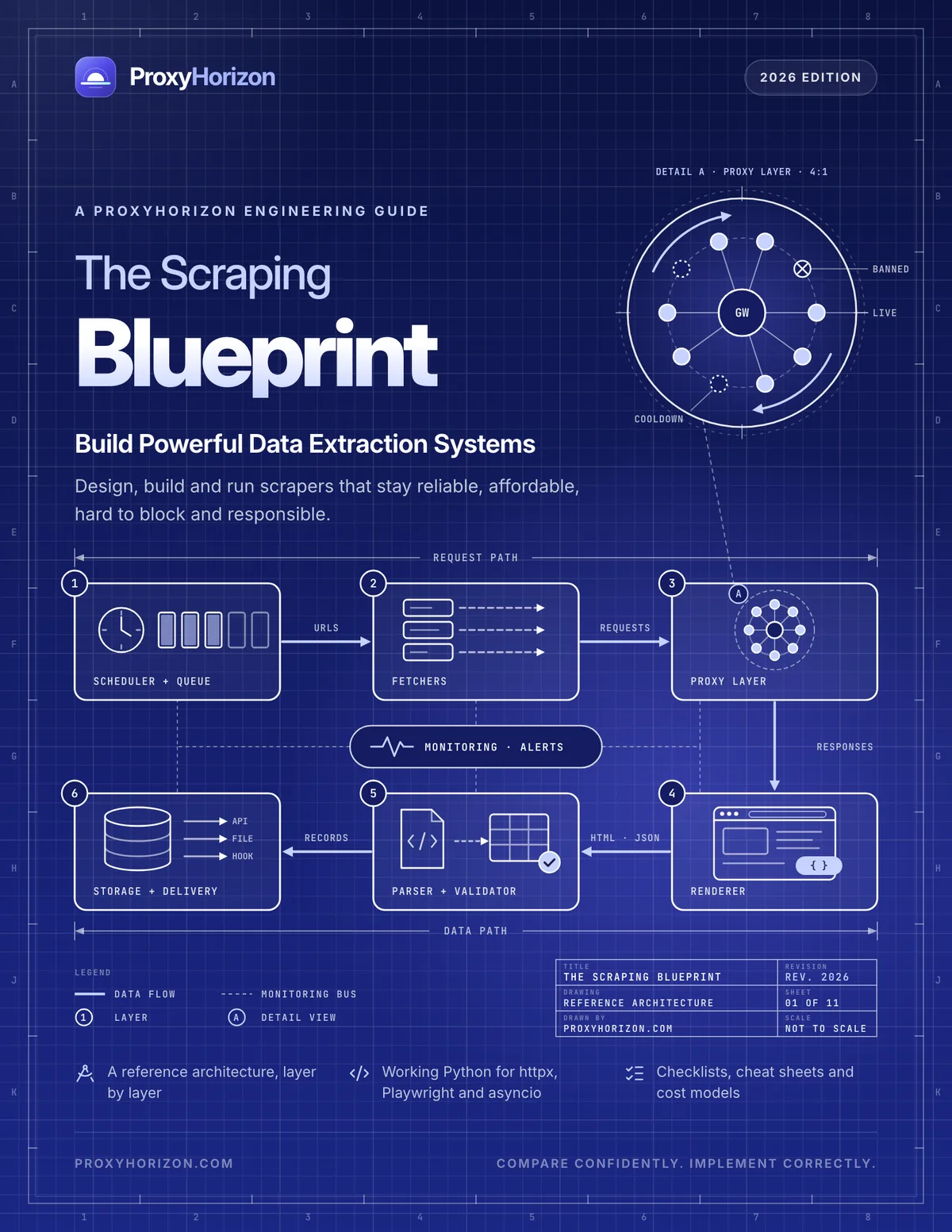
60 pages · Free PDF
The Scraping Blueprint
The free engineering guide to building scraping systems that stay reliable, affordable and unblocked.
Read more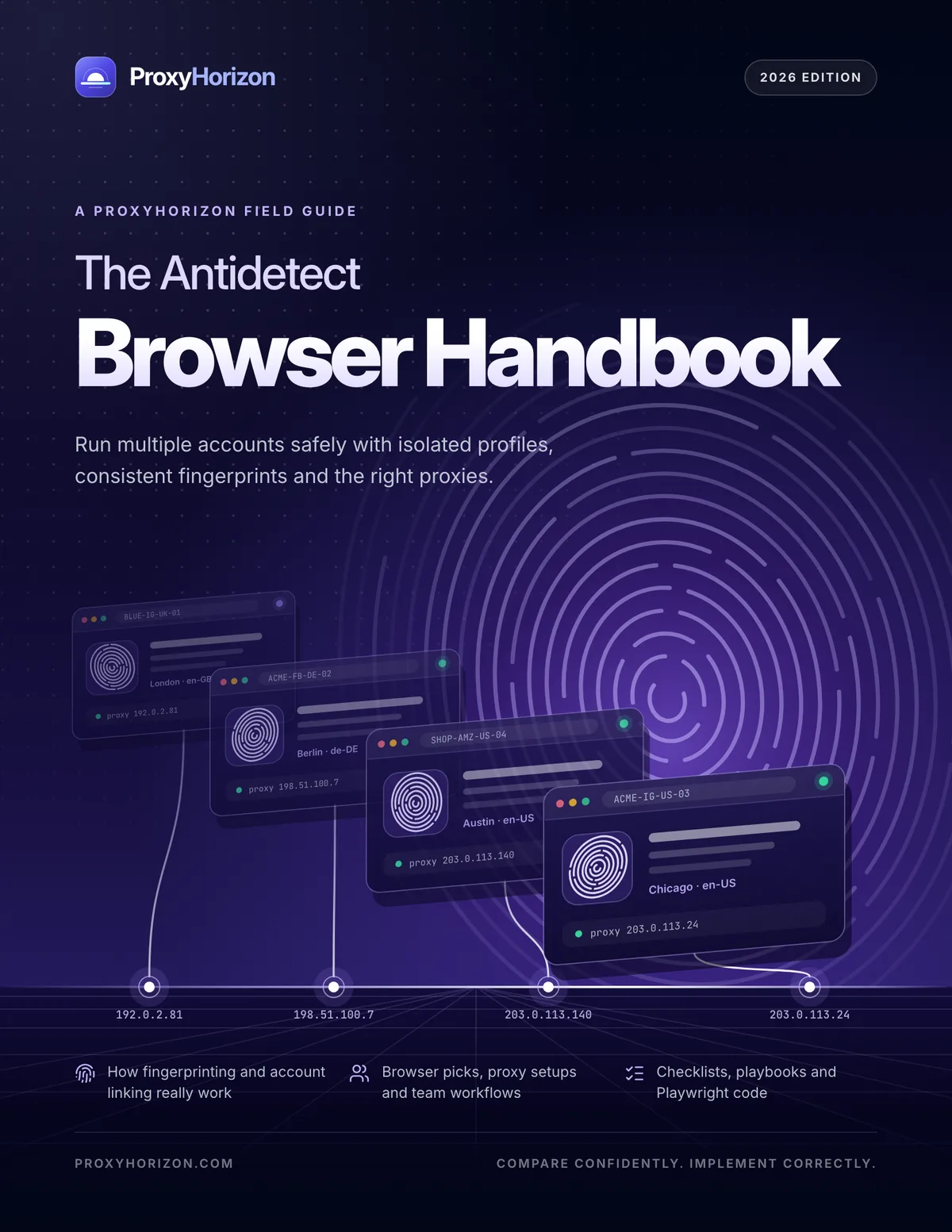
59 pages · Free PDF
The Antidetect Browser Handbook
The free guide to running multiple accounts safely with profiles, fingerprints and proxies.
Read moreGet the playbook, free
59 pages, no sign-up, no email gate. Start with the 30-day launch plan in the appendix and have your first list running this month.