Best VPN Services for Privacy in 2026
The best VPN services for privacy in 2026 — audited no-logs, RAM-only servers, and honest jurisdiction analysis, plus what a VPN really can and cannot hide.
Your internet activity is worth money to a lot of people who never asked your permission. In the United States, internet providers are legally allowed to collect and sell customers’ browsing data, a door Congress opened when it repealed the FCC’s broadband privacy rules in 2017. Add advertisers, data brokers, and the automated trackers on nearly every page you visit, and "just browsing" quietly becomes a dossier.
A good VPN is the single most effective tool for pulling that curtain shut. It encrypts your traffic so your ISP sees noise instead of history, and it hides your real IP from the sites you visit. But here is the uncomfortable truth most "best VPN" lists bury: the VPN itself can see what your ISP no longer can. So the entire game is trust, and trust has to be earned with audits, jurisdiction, and proof, not marketing.
This guide leads with that reality. You will get our shortlist of the best VPN services for privacy in 2026, the exact criteria that separate a genuine privacy tool from a data-harvesting one, a clear look at jurisdiction and the "Eyes" alliances, an honest section on what a VPN can’t hide, and the traps that quietly undo your privacy. By the end, you will be able to choose with confidence.
- For real privacy, an independently audited no-logs policy matters more than any other single feature.
- Look for strong modern encryption (AES-256 or ChaCha20), WireGuard or OpenVPN, and an always-on kill switch.
- Jurisdiction counts: providers based outside intrusive surveillance alliances offer stronger legal protection.
- A VPN hides your traffic and IP, but pair it with good habits, since it is not total anonymity.
What Makes a VPN Good for Privacy?
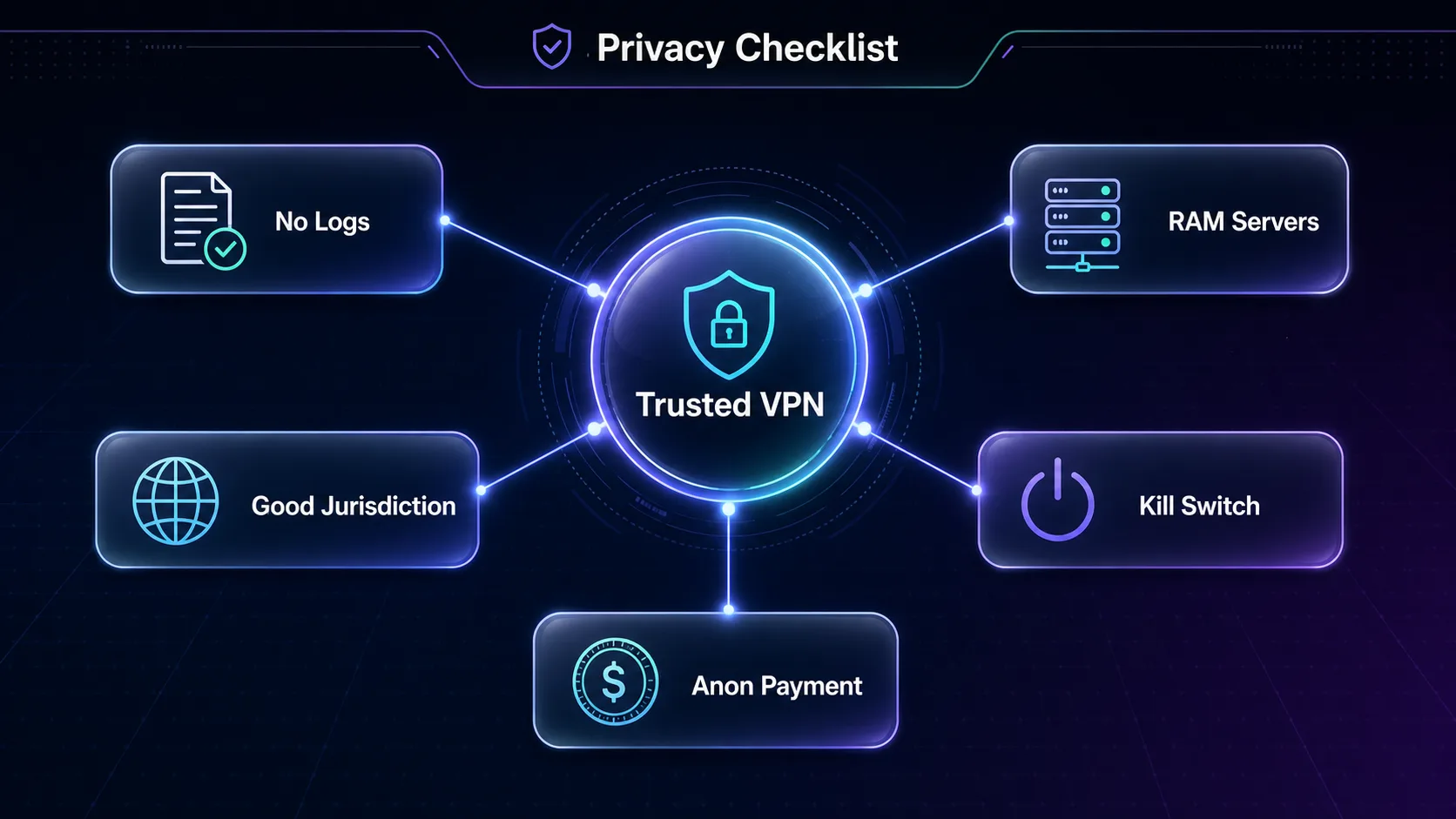
Speed and streaming get the headlines, but privacy comes down to a specific, unglamorous checklist. These are the things we actually weigh:
- Independently audited no-logs policy: a promise is not proof. The best providers hire outside firms to verify they store nothing that could identify you.
- RAM-only (diskless) servers: servers that hold data only in memory wipe everything on reboot, so there is nothing to seize or hand over.
- Privacy-friendly jurisdiction: where a company is legally based determines what governments can compel it to log or reveal.
- Strong, modern encryption: AES-256 or ChaCha20 with WireGuard/OpenVPN, plus a working kill switch and leak protection.
- Anonymous payment and signup: cash, crypto, or no-email accounts mean the provider cannot tie the service to your identity.
- Ownership and transparency: who owns the company, and do they publish transparency reports and open-source apps?
Our take: if a VPN nails audits, jurisdiction, and RAM servers, it is a serious privacy tool. If it is vague on all three, especially a "free" one, assume you are the product. New to the basics? Start with what a VPN is and how it works.
The Best VPN Services for Privacy in 2026
How we picked: we prioritized independently audited no-logs policies, RAM-only infrastructure, jurisdiction, encryption and leak protection, anonymous payment options, and transparency (ownership, open-source apps, court-tested claims) over raw speed or streaming perks. Where our read is based on published audits and documentation rather than a live lab test, we say so. A brief disclosure: some links here are affiliate links, and we may earn a commission, it never changes our rankings or our verdicts.
1Mullvad VPN
Best for genuine anonymity. Mullvad is the privacy purist’s VPN, and it earns the title. There are no email addresses and no personal accounts, you get a random numbered account ID, and you can literally mail them cash to pay. That design means there is almost nothing linking the service to you in the first place.
Back it with a flat price, RAM-only servers, open-source apps, and repeated independent audits, and you have the network most privacy experts personally trust. The catch: it is spartan. Streaming unblocking is inconsistent and there are no flashy extras. If your priority is anonymity over Netflix, nothing here beats it.
2Proton VPN

Best open-source and audited option. From the Swiss team behind Proton Mail, Proton VPN pairs a strong privacy pedigree with rare transparency: fully open-source apps across platforms, independent audits, and a Secure Core feature that routes your traffic through hardened servers in privacy-friendly countries before it exits.
Switzerland’s strong privacy laws and Proton’s no-logs stance make it a top choice when trust matters most, and its free tier is the only genuinely private one we recommend. The trade-off is that top speeds and Secure Core are gated to paid plans. For privacy advocates, it is the standout. Compare it in our Surfshark vs Proton VPN breakdown.
3NordVPN

Best all-round privacy and speed. NordVPN is the mainstream pick that does not compromise on privacy. It runs entirely on RAM-only servers, has passed multiple independent no-logs audits, and is based in Panama, well outside the major surveillance alliances. Its NordLynx protocol (built on WireGuard) keeps it among the fastest networks around.
Extras like Threat Protection, Double VPN, and Onion-over-VPN add real privacy depth without the clunkiness of niche tools. The honest caveat: it is pricier than budget rivals and pushes long-term plans hard. For most people wanting strong privacy and everyday usability, it is the safest bet. See how it stacks up in NordVPN vs Surfshark.
4ExpressVPN

Best RAM-only reliability. ExpressVPN pioneered the RAM-only server model with its TrustedServer technology, meaning every server wipes on reboot and no data is written to disk. Based in the British Virgin Islands, a jurisdiction with no data-retention laws, and independently audited, it has a long, clean track record.
Its Lightway protocol is fast and lightweight, and the apps are the most polished in the category. The catch is simply price: it is one of the more expensive options. But for a set-and-forget privacy VPN that consistently just works, it is hard to fault.
5OVPN

Best court-proven no-logs. OVPN is a Swedish, privacy-obsessed provider running fully diskless RAM servers, and crucially, its no-logs claim has been tested in court and held up, with the company unable to produce data it does not keep. That is proof, not a promise.
It publishes detailed transparency about its infrastructure and even owns much of its hardware. The trade-off is a smaller server network and a more technical, less hand-holding experience. For users who want their privacy claims backed by legal precedent rather than marketing, OVPN is a quietly exceptional choice.
6Private Internet Access
Best open-source at scale. Private Internet Access (PIA) combines a genuinely huge server network with fully open-source apps and a no-logs policy that has been proven in US court cases multiple times, investigators subpoenaed data and PIA had none to give. That real-world track record carries weight.
It is endlessly configurable, cheap on longer plans, and supports unlimited devices. The honest caveat: it is US-based, which some privacy hardliners dislike, though its court-tested no-logs record largely answers that concern. For transparency-minded users who also want scale and value, it is a strong pick.
7Surfshark

Best budget privacy. Surfshark delivers a serious privacy feature set at a friendly price: RAM-only servers, independent audits, a strict no-logs policy, and privacy extras like Camouflage mode and a rotating IP option. It also allows unlimited simultaneous connections, so you can protect every device you own.
Speeds are strong via WireGuard, and the apps are beginner-friendly. The trade-off is that it is Netherlands-based (a 9-Eyes country), though its audited no-logs policy mitigates the concern in practice. For anyone wanting audited privacy without the premium price, it is the value champion.
Privacy Features Compared
Here is how our seven picks line up on the features that actually protect you. (Always confirm current specifics on the provider’s site.)
| VPN | Jurisdiction | RAM-Only | Audited No-Logs | Anon. Payment |
|---|---|---|---|---|
| Mullvad | Sweden | Yes | Yes | Cash + crypto |
| Proton VPN | Switzerland | Partial | Yes | Crypto |
| NordVPN | Panama | Yes | Yes | Crypto |
| ExpressVPN | BVI | Yes | Yes | Crypto |
| OVPN | Sweden | Yes | Court-proven | Crypto |
| PIA | USA | Yes | Court-proven | Crypto |
| Surfshark | Netherlands | Yes | Yes | Crypto |
Jurisdiction and the 14 Eyes Explained
Where a VPN is legally based is not a technicality, it decides what governments can force it to do. The Five, Nine, and Fourteen Eyes are intelligence-sharing alliances of countries that pool surveillance data. A VPN headquartered inside one can, in theory, be compelled to log a user and share that data with member states.
That is why privacy-first providers cluster in places like Switzerland, Panama, and the British Virgin Islands, jurisdictions outside these alliances with no mandatory data-retention laws. In plain English: a no-logs policy is your first line of defense, but a friendly jurisdiction is the backup that makes the policy meaningful.
| Alliance | Example Members | Privacy Impact |
|---|---|---|
| Five Eyes | US, UK, Canada, Australia, NZ | Deepest intelligence sharing, most caution |
| Nine Eyes | + Netherlands, France, Denmark, Norway | Extended sharing, audits matter more here |
| Fourteen Eyes | + Germany, Italy, Spain, Belgium, Sweden | Broad sharing, favor proof over location |
| Outside (privacy havens) | Switzerland, Panama, BVI | No mandatory retention, preferred base |
Expert take: jurisdiction matters, but it is not the whole story. A US-based VPN with a court-proven no-logs record (like PIA) can be more trustworthy than a "privacy haven" provider with no audits at all. Proof beats geography.
What a VPN Can and Can’t Hide
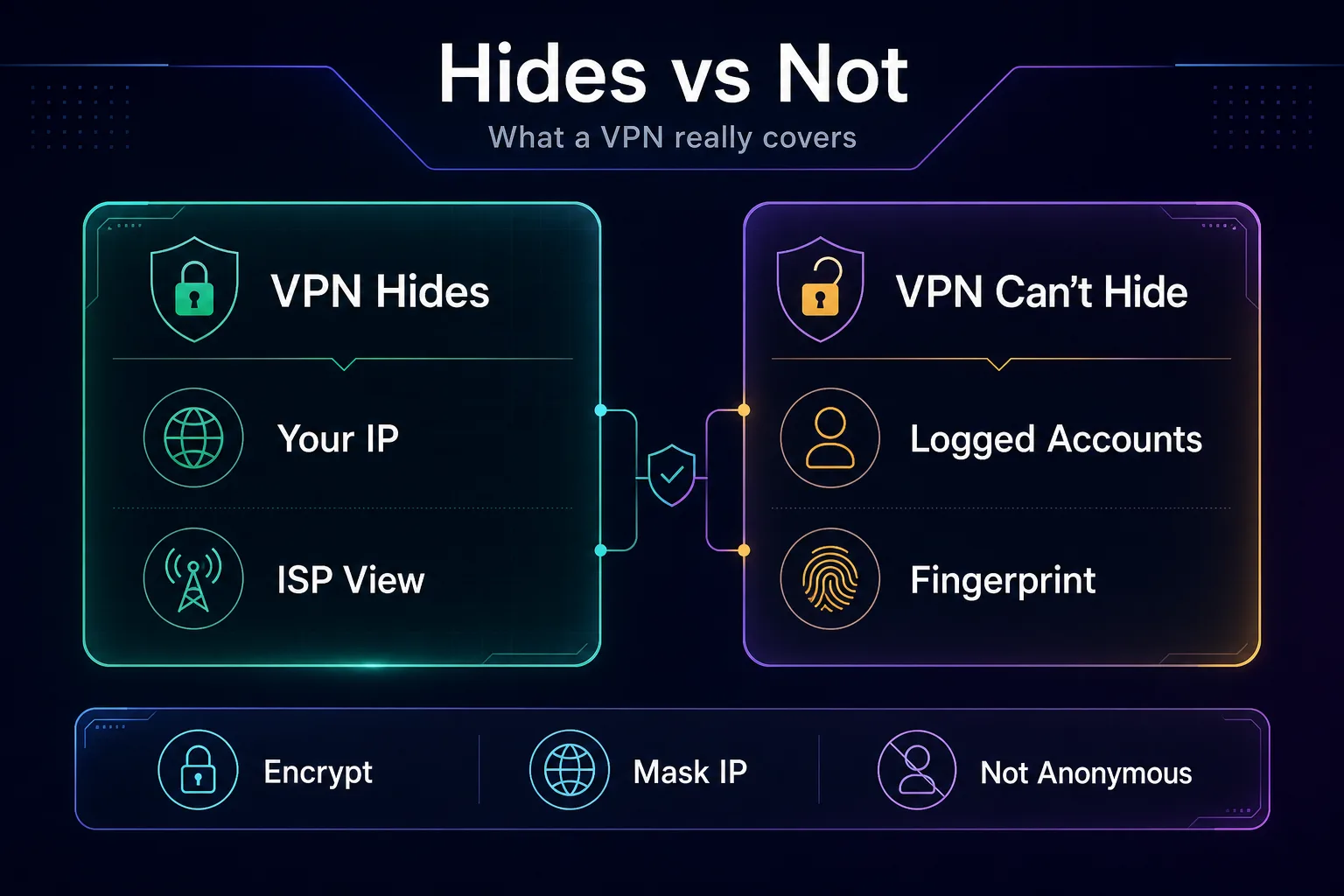
This is the section most VPN marketing desperately avoids, and skipping it does readers a disservice. A VPN is powerful, but it is not an invisibility cloak.
What a VPN hides: your browsing from your ISP, your real IP from websites, and your traffic from snoops on public Wi-Fi. That is a lot, and for everyday privacy it is exactly what you want.
What a VPN does NOT hide: anything you do while logged into an account (Google still knows it is you), your browser fingerprint, tracking cookies, and the activity itself from the VPN provider. It also does not make you anonymous to a determined, targeted investigation. For the tracking a VPN can’t stop, see how websites track you online, and for stronger anonymity, our VPN vs Tor comparison.
The uncomfortable truth: a VPN shifts your trust from your ISP to your VPN provider. It does not eliminate trust. That is precisely why which provider you choose, audited, well-governed, transparent, matters more than the fact that you use one at all.
How to Choose a Privacy VPN
1What is your threat model?
Be honest about who you are hiding from. Escaping ISP tracking and advertisers is a modest bar that almost any audited VPN clears. Evading a nation-state is a different sport that needs Tor-level thinking. Match the tool to the actual threat, not the scariest one imaginable.
2Does it have real proof, not promises?
Prioritize independent audits, RAM-only servers, and, best of all, a no-logs claim tested in court. Marketing language like "military-grade" and "100% anonymous" is meaningless; verifiable proof is everything.
3How anonymous do you need signup to be?
If you want minimal ties to the service, favor providers that accept cash or crypto and require no email, Mullvad is the gold standard. If you are just escaping trackers, a normal account is fine.
4Is the price honest for the long term?
Cheap first-year deals often balloon on renewal. Read the renewal price, not just the promo. A flat, transparent price (Mullvad) or a court-tested budget option (PIA) can beat a flashy discount.
Common Privacy Mistakes to Avoid
1Trusting free VPNs with your data
Running servers costs money. If a VPN is free and not backed by a trusted name like Proton, it very often monetizes your data, the exact opposite of privacy. Some free VPNs have been caught logging and selling traffic. Stick to reputable free tiers or pay a few dollars. Our guide to genuinely safe free VPNs covers the rare exceptions.
2Ignoring the kill switch
If your VPN drops and you have no kill switch, your real IP leaks instantly and silently. Always enable it. A privacy VPN without an active kill switch is a privacy VPN with an open back door, see how a kill switch works.
3Staying logged into everything
A VPN cannot hide you while you are signed into Google, Facebook, or Amazon, they identify you by your account, not your IP. For truly private sessions, use a separate browser or private window with no logins.
4Choosing on speed alone
The fastest VPN is worthless for privacy if it logs you. Speed is a tiebreaker, not the deciding factor. Weigh audits and jurisdiction first, then compare performance among the finalists.
5Forgetting your browser fingerprint
Your browser leaks a surprising amount, fonts, screen size, extensions, that a VPN does nothing to mask. Pair your VPN with anti-fingerprinting measures or a privacy browser for meaningfully better anonymity.
Tips for Maximizing Your VPN Privacy
- Always keep the kill switch on. It is your safety net when the connection drops.
- Prefer WireGuard or OpenVPN. Modern protocols with strong ciphers, avoid legacy PPTP entirely.
- Pay anonymously when it matters. Cash or crypto for the most sensitive use cases.
- Run a DNS leak test. Confirm your VPN is actually routing DNS, not leaking to your ISP.
- Combine with private browsing habits. A VPN plus a clean browser and no logins beats a VPN alone.
Frequently Asked Questions
Conclusion
The best VPN for privacy is not the one with the loudest "military-grade" marketing, it is the one that can prove it protects you. For genuine anonymity, Mullvad is untouchable. Proton VPN is the open-source, audited pick; NordVPN the best all-rounder; ExpressVPN the polished RAM-only veteran; OVPN and PIA the court-proven no-loggers; and Surfshark the audited budget champion.
Whichever you choose, remember what privacy actually requires: audited no-logs, a sensible jurisdiction, RAM-only servers, a live kill switch, and realistic expectations about what a VPN can and cannot hide. A VPN moves your trust, choose a provider that has earned it.
Ready to decide? Compare privacy specs side by side in our VPN directory, put two head-to-head with our comparison tool, or go deeper with our guide on whether governments can track VPN users. Protect the everyday, and choose on proof, not promises.