Are Free VPNs Safe? The Honest Answer (2026)
Are free VPNs safe? Mostly no. How free VPNs make money, the real risks, when free is actually okay, how to spot a safe VPN, and the trustworthy alternatives.
![Are Free VPNs Safe? The Honest Answer ([year])](/_next/image?url=https%3A%2F%2Fproxyhorizon.com%2Fcdn%2Fblog-images%2Fare-free-vpns-safe-1-msk66t65.webp&w=3840&q=75)
A VPN is supposed to protect your privacy. So there's a painful irony in the fact that many free VPNs do the exact opposite: they log what you do, sell it to advertisers, and in some cases ship with malware baked in. A widely cited study of hundreds of free Android VPN apps (CSIRO) found that a large share contained tracking libraries or malware, and many leaked traffic they claimed to protect. That's the uncomfortable backdrop to a simple question.
So, are free VPNs safe? The honest answer is that most are not, and a small handful genuinely are. The difference comes down to how the service makes money. Running a global VPN network costs real money, and if you're not paying for it, something else usually is, often your data. This guide separates the dangerous majority from the trustworthy exceptions.
We'll cover how free VPNs actually fund themselves, the specific risks to watch for, when a free VPN is genuinely fine to use, and how to tell a safe one from a data-harvesting trap. If you just want vetted no-cost options, our roundup of the best free VPNs lists the ones worth trusting; this is the safety explainer behind it.
The Short Answer: Most Free VPNs Are Not Safe
Let's not bury the verdict. The majority of free VPNs, especially unknown apps from an app store's "top free" list, are a bad trade for your privacy. They range from merely useless (weak protection, constant ads) to actively harmful (logging, selling data, or carrying malware). Installing one to protect your privacy can leave you more exposed than using no VPN at all.
The exceptions are the free tiers of established, paid providers, companies like Proton that offer a limited free plan as a taste of their paid product. Those are held to the same standards as their paid service, which is what makes them trustworthy. The rule of thumb: a free VPN is only as safe as the company behind it, and an anonymous app with no clear business model is the opposite of safe.
How "Free" VPNs Actually Make Money
Infrastructure, bandwidth, servers, and engineers all cost money, so a VPN with no revenue can't survive on goodwill. When there's no subscription, the money has to come from somewhere, and the usual sources are exactly what you'd want a privacy tool to avoid.
The most common model is selling your data: your browsing activity, and sometimes more, is logged and sold to data brokers or advertisers. Others rely on injecting ads into your traffic, or even hijacking your device's spare bandwidth to resell as part of a botnet or proxy network. In plain English, with most free VPNs, you're not the customer, you're the product. That's not cynicism; it's the economics of running a network with no other income.
The Real Risks of Free VPNs
The danger isn't abstract. Free VPNs expose you through a handful of concrete mechanisms, and any one of them can undo the privacy you installed the app for.
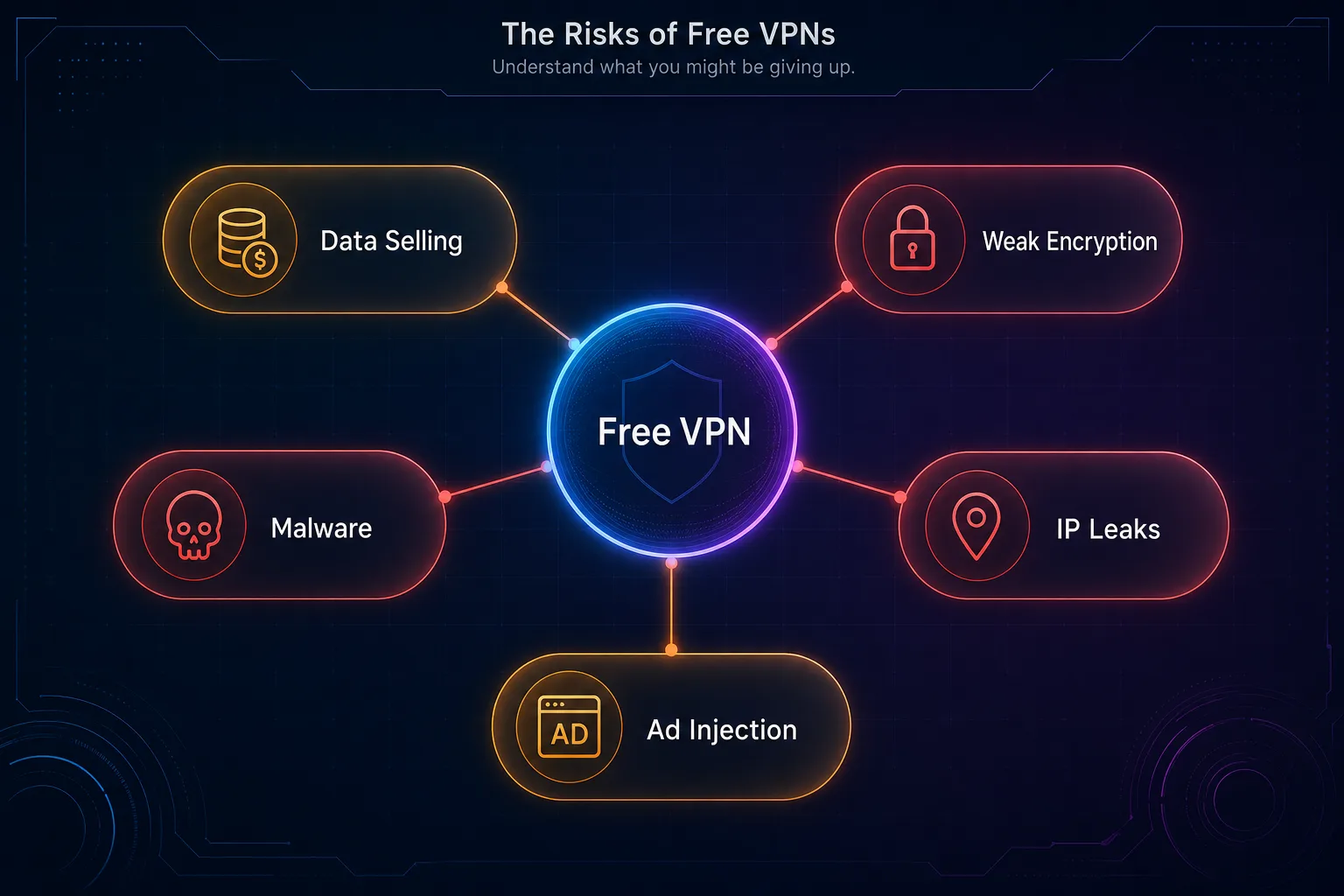
1Logging and Selling Your Data
The headline risk. Many free VPNs keep detailed logs of the sites you visit and the data you send, then sell that to advertisers and data brokers. This is the exact activity a VPN is supposed to prevent, which makes a logging free VPN worse than useless. Always check for an independently audited no-logs policy, which cheap free apps almost never have.
2Weak or Missing Encryption
Strong encryption is expensive to implement and maintain. Free VPNs often cut corners with outdated protocols or weak ciphers, and some barely encrypt at all. That leaves your traffic readable to anyone positioned to intercept it, defeating the point of the tunnel entirely.
3Malware and Shady Apps
Some free VPN apps, particularly unknown ones, bundle malware, adware, or aggressive trackers. You install a "privacy" tool and hand a stranger a foothold on your device. This is the risk the CSIRO research flagged most sharply, and it's why the source of the app matters as much as its features.
4DNS and IP Leaks
A VPN is only working if it actually hides your real IP and DNS requests. Poorly built free VPNs frequently leak both, quietly exposing your identity and location while showing you a reassuring "connected" status. You can spot this by testing your setup, and a real kill switch, which most free apps lack, is what prevents leaks when the connection drops.
5Ad Injection and Bandwidth Theft
Beyond selling data, some free VPNs inject their own ads into the pages you visit, or borrow your idle bandwidth to resell to third parties. At best it's annoying; at worst your connection becomes an exit node for someone else's traffic, which can implicate you in activity you never performed.
Free vs Paid VPNs: The Real Difference
The gap between a typical free VPN and a reputable paid one isn't about a few extra features. It's a difference in incentives, and incentives decide how your data gets treated.
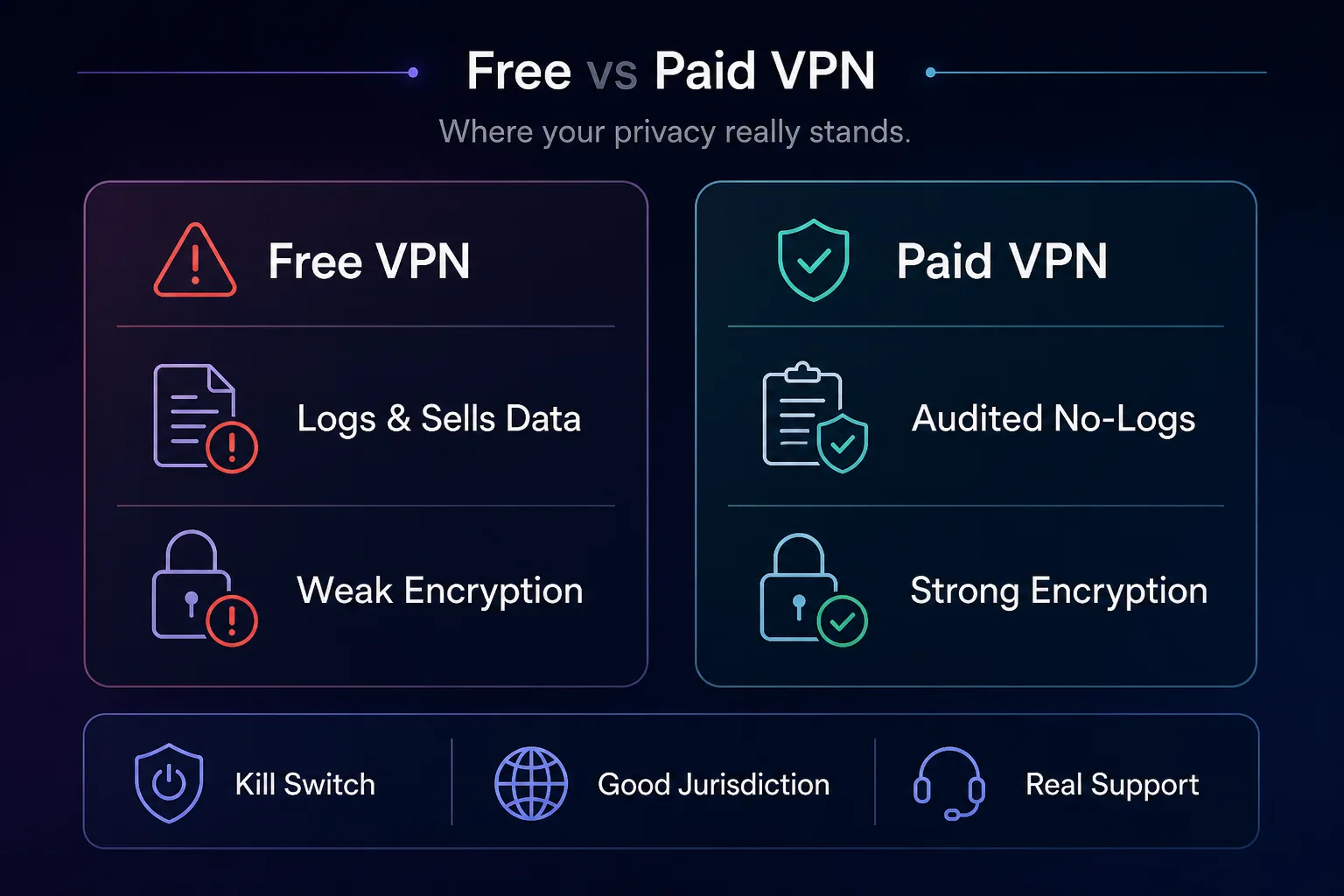
| Factor | Typical Free VPN | Reputable Paid VPN |
|---|---|---|
| Business model | Sells data or shows ads | You pay, so you're the customer |
| Logging | Often logs and shares activity | Independently audited no-logs |
| Encryption | Weak or outdated | Strong and modern (AES-256, WireGuard) |
| Speed and data | Throttled, tight data caps | Fast, usually unlimited |
| Servers | Few and crowded | Thousands worldwide |
| Support and updates | Minimal, patchy security fixes | Active support and regular updates |
When a paid plan costs a few dollars a month, the "free" alternative that monetizes your data is rarely the bargain it looks like. For a refresher on what the tool is meant to do in the first place, see our explainer on how a VPN works.
When a Free VPN Is Actually Okay
This isn't a blanket "never use free." There's a right way to use one. The free tier of a reputable, audited provider is genuinely safe, because it's held to the same privacy standards as the paid product and the company already has a viable business model that doesn't involve selling you out.
A trustworthy free tier works well for light, occasional use: checking email on hotel Wi-Fi, casual browsing, or simply trying a provider before you subscribe. What it won't do is match a paid plan on speed, server choice, or unlimited data, which is the honest trade for paying nothing. The key distinction is freemium from a known name versus an anonymous "free VPN" app, the first is a limited version of a real product, the second is a question mark you shouldn't install.
How to Spot a Safe VPN
Whether free or paid, a trustworthy VPN shows the same signals. Run any service through this checklist before you trust it with your traffic.
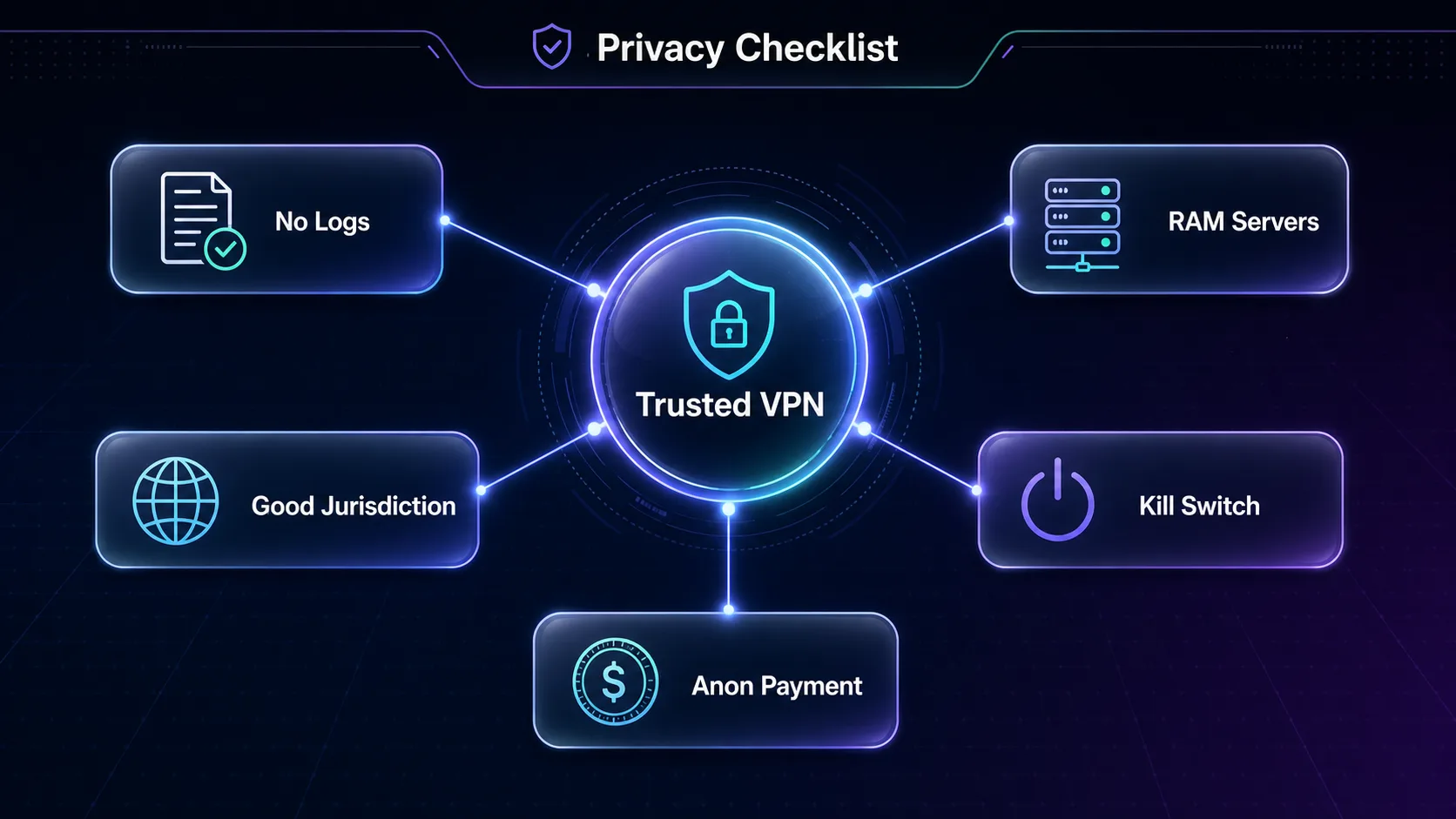
Look for an independently audited no-logs policy, not just a marketing claim, so a third party has verified the provider keeps nothing. Check the jurisdiction: a privacy-friendly country beats one with aggressive data-retention laws. Confirm it uses strong, modern encryption and offers a kill switch to prevent leaks. Favor providers that are transparent about ownership and publish regular audits or transparency reports. And weigh its record on whether governments can track VPN users through it. For deeper vetting criteria, the EFF's Surveillance Self-Defense guide is an excellent, neutral reference.
Safer Alternatives to Risky Free VPNs
If you want real safety without gambling on an unknown app, these three are the ones we recommend. How we picked: we favored audited no-logs policies, strong encryption, reliable kill switches, and, for the free option, a genuinely trustworthy free tier. A quick disclosure: some links below are affiliate links, and we may earn a commission if you subscribe, which never changes our picks.
| VPN | Our rating | Genuine free tier | Servers | From | Audited no-logs |
|---|---|---|---|---|---|
| Proton VPN | 4.7/5 | Yes | 4,800+ | $4.49/mo | Yes |
| NordVPN | 4.6/5 | No | 6,400+ | $3.59/mo | Yes |
| Surfshark | 4.5/5 | No | 3,200+ | $2.19/mo | Yes |
1Proton VPN

Proton VPN is the answer to "is any free VPN actually safe?" It runs the rare genuinely trustworthy free tier: unlimited data, no ads, no logging, and no catch beyond fewer server locations than the paid plan. Based in Switzerland with open-source, independently audited apps, it holds its free users to the same privacy standard as paying ones.
The free plan is ideal for light use and for testing before you upgrade. Step up to paid and you unlock Secure Core routing, more servers, and higher speeds. If you refuse to pay but still want safety, this is the one to install.
2NordVPN

NordVPN is the all-round paid pick when you want maximum reliability. Its audited no-logs policy, huge server network, and strong encryption make it a dependable everyday VPN, and Threat Protection adds malware and tracker blocking on top. There's no free tier, but the long-term plans are inexpensive for what you get.
For anyone graduating from a sketchy free app to something they can actually trust, NordVPN is a safe, feature-complete default. Its speeds and app polish are among the best in the category.
3Surfshark

Surfshark is the value champion, and its standout feature is unlimited simultaneous connections, so one cheap subscription covers every device you own. It pairs an audited no-logs policy with strong encryption, a reliable kill switch, and CleanWeb ad and tracker blocking.
At its lowest long-term price it's the cheapest way to replace a risky free VPN with a genuinely safe one. For families or gadget-heavy households, the unlimited-device policy makes it especially good value. Compare all three in our VPN directory.
Common Mistakes People Make With Free VPNs
Most free-VPN trouble comes from a few predictable errors. Avoid these and you dodge the worst of it.
1Installing Unknown Apps From the "Top Free" List
An app store ranking is not a trust signal. Many top free VPNs are anonymous apps with no clear owner and no audit. Stick to the free tiers of established, named providers rather than whatever tops the chart this week.
2Assuming "No Logs" Marketing Is True
Any app can print "no logs" on its store page. Without an independent audit, it's just a claim, and free apps are the least likely to back it up. Treat unverified no-logs promises as marketing, not fact.
3Using a Free VPN for Sensitive Tasks
Banking, work logins, and anything private do not belong on an unvetted free VPN. If the app is logging or leaking, you've handed over exactly the data you most needed to protect. Reserve sensitive activity for a VPN you actually trust.
4Ignoring Permissions
A VPN app asking for contacts, location, or other unrelated permissions is a red flag. Legitimate VPNs need very little beyond the network connection. Over-broad permission requests often signal a data-harvesting operation.
5Believing Free VPNs Make You Anonymous
Even a decent free VPN doesn't make you invisible, and a bad one actively tracks you. A VPN masks your IP; it doesn't erase accounts you're logged into or your browser fingerprint. Buying into VPN myths leads people to take risks they wouldn't otherwise.
Frequently Asked Questions
The Bottom Line
Are free VPNs safe? Mostly no, with a few important exceptions. The typical free VPN, especially an unknown app, funds itself by logging and selling your data, skimping on encryption, or worse, which means it undermines the very privacy you wanted. The trustworthy exceptions are the free tiers of reputable, audited providers that already have a real business model.
If you want no-cost safety, Proton VPN's free plan is the standout. If you can stretch to a few dollars a month, NordVPN and Surfshark deliver audited no-logs privacy without the free-VPN gamble. Whatever you choose, run it through the safety checklist first, and browse vetted options in our VPN directory before you install anything that touches your traffic. Your privacy is worth more than the price of a coffee, which is roughly what a safe VPN costs.
![The Best Data Extraction APIs to Try in [year]](/_next/image?url=https%3A%2F%2Fproxyhorizon.com%2Fcdn%2Fblog-images%2Fbest-data-extraction-apis-1-mufdevwh.webp&w=3840&q=75)
![Best SERP APIs ([year]): Compared for Accuracy, Pricing & AI](/_next/image?url=https%3A%2F%2Fproxyhorizon.com%2Fcdn%2Fblog-images%2Fbest-serp-apis-1-mufdet7y.webp&w=3840&q=75)
![How to Add an MTProto Proxy to Telegram ([year])](/_next/image?url=https%3A%2F%2Fproxyhorizon.com%2Fcdn%2Fblog-images%2Fhow-to-add-mtproto-proxy-telegram-1-mu9ha99k.webp&w=3840&q=75)